punctum books
This page shows the latest publications (in descending order of publication date) from punctum books.
Metadata is licensed as Creative Commons Zero (CC0) and is retrieved from Thoth’s open APIs.
Last updated: 2026-10-25 00:00:24
October 2026
2×6
Author: Nick Montfort
Author: Serge Bouchardon
Author: Carlos Léon
Author: Natalia Fedorova
Author: Andrew Campana
Author: Aleksandra Małecka
Author: Piotr Marecki
Earth, Milky Way: punctum books, 2026
https://doi.org/10.53288/0580.1.00
2×6 consists of short “stanzories”—stanzas that are also stories, each one relating an encounter between two people. Appearing in English, French, Spanish, Russian, Japanese, and Polish, the stanzories are generated by a similar underlying process, even as they do not neatly correspond to one another the way a translation typically does to a source text. These sixfold verses are generated by six short computer programs, the code of which is also presented in full. These simple programs can endlessly churn out combinatorial lines that challenge readers to determine to whom “she” and “he,” and “him” and “her,” refer, as well as which is the more powerful signifier, which the underdog. As John Cayley writes, “Gender is the chief generative obstacle here—making more than two times six—distributed across the natural grammars of these micro-dramas, with their psychosocial, vocational, and hierarchical narrative vectors.”
This title is a second edition of a book originally published by Les Figues Press, released as part of punctum’s Special Collections project.
Zen for Record
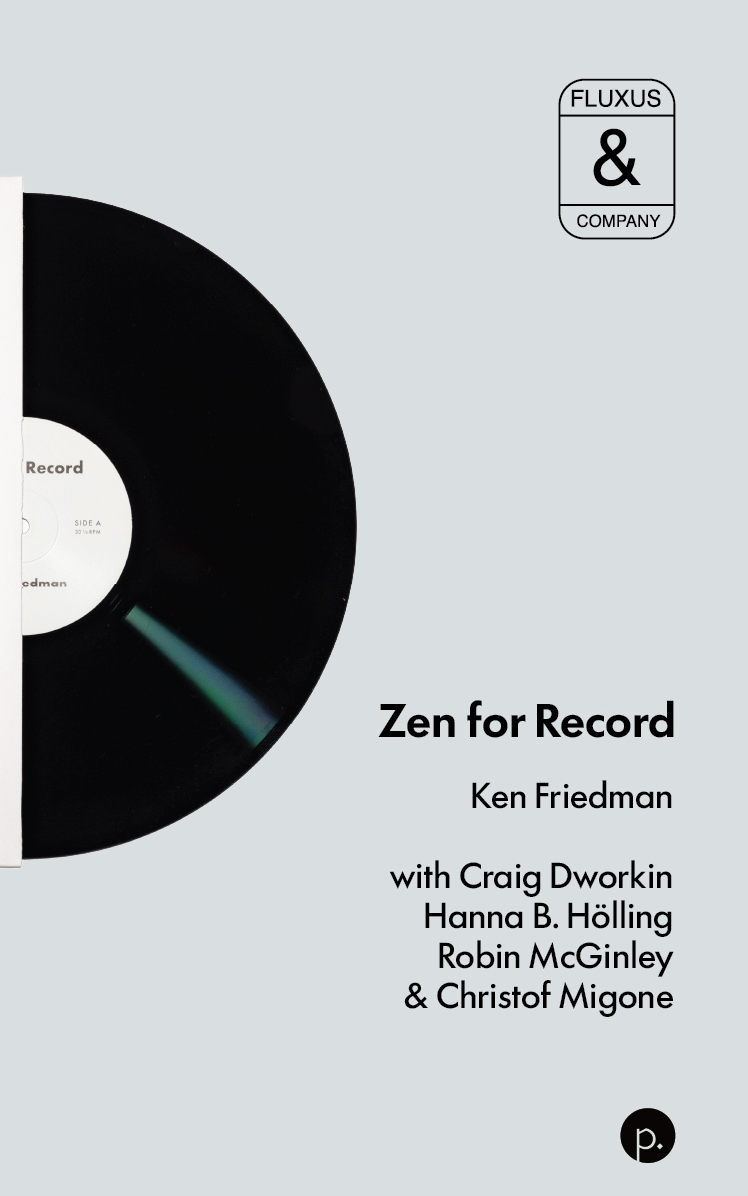
Author: Ken Friedman
Contributions by: Craig Dworkin
Contributions by: Hanna B. Hölling
Contributions by: Robin McGinley
Contributions by: Christof Migone
Earth, Milky Way: punctum books, 2026
https://doi.org/10.53288/0588.1.00
Zen for Record gathers five essays around Ken Friedman’s 1966 Fluxus event score instructing the production of “a phonograph record with no sound on it.” Originating as a found object, the work has migrated across six decades and multiple incarnations, from an unrealized concept to the LP edition that occasions this volume.
These essays accompany Friedman’s account of the Fluxus origins of the work, but they approach the silent record from radically different angles. Craig Dworkin situates Zen for Record within a broader aesthetics of negation and conceptual art’s engagement with the zero-degree of content. Christof Migone spirals through the paradoxes of inscribing nothing and the impossibility of a truly soundless playback. Robin McGinley traces a remarkable counterhistory of the silent record as pop artifact, from 1950s jukebox novelties to Vulfpeck’s album Sleepify. Finally, Hanna B. Hölling reads the work through sonic materialism, preservation theory, and the politics of silencing, asking what it means for a concept to survive the obsolescence of its successive carriers.
Touching on Fluxus event scores and Cagean silence, the political economy of streaming platforms, and the conservation of time-based media, these essays stage a sustained interdisciplinary meditation on silence as material, medium, commodity, and philosophical provocation.
Janky Materiality: Artifice & Interface
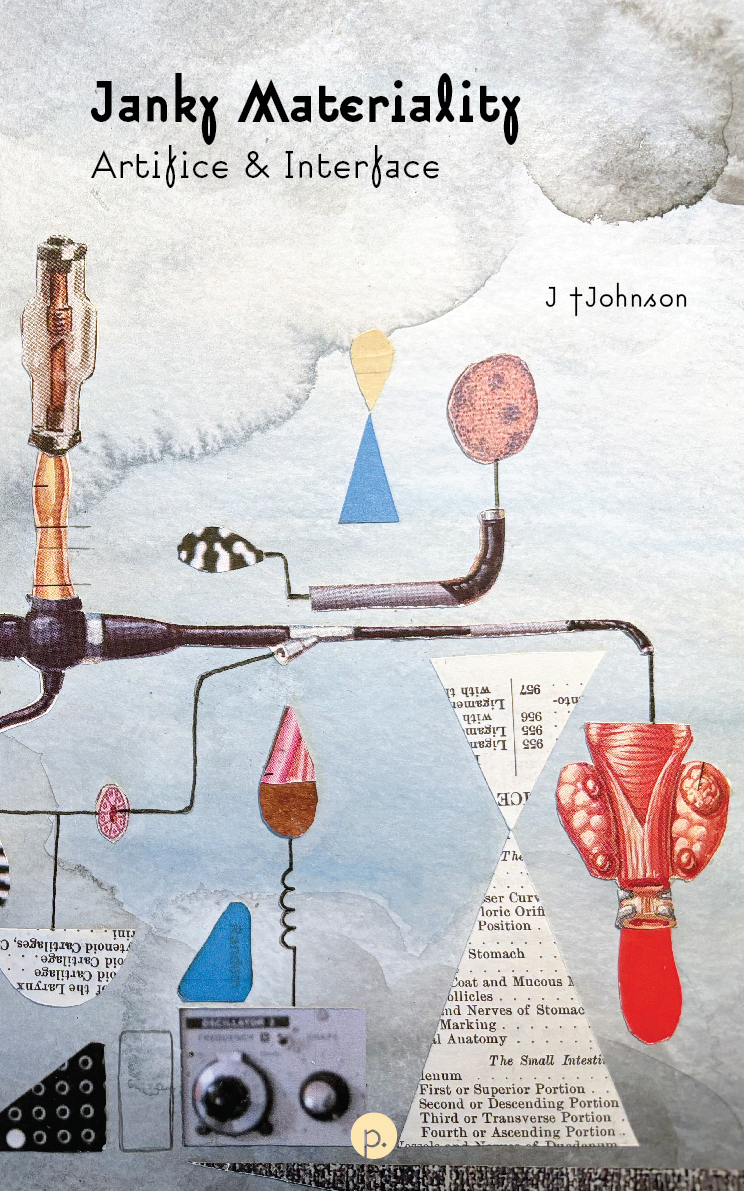
Author: J †Johnson
Earth, Milky Way: punctum books, 2026
https://doi.org/10.53288/0522.1.00
Janky materiality works by not working. It is the spirit in the machine, the ghost in language, the provisional operation. It is a musicological poetics run through a patchwork apparatus.
Janky Materiality: Artifice & Interface is a transdisciplinary performative critical investigation of analog-digital interface and materiality, language-oriented poetry and digital language art, experimental electronic music and modular synths, and the technology of film, album, and book.
Janky Materiality explores blurry intersections and cracked interfaces between page, screen and speaker, analog and digital practice. With reference to avant-garde poetics, digital language art, experimental electronic music and modular synths, chance operations and oracular knowing, Johnson thinks about the ways digital material practice extends the post-structural field, as page-based practices are (further) destabilized by computer-based experiments. Language itself is a janky technology that works (at least temporarily) through its own failures, so that digital mediation serves to further break and rewire language operations. Meanwhile, the book also explores sonification and the study of waveforms: hybrid audio-visual objects that can be materially sculpted and analyzed.
Ultimately, Janky Materiality presents a theory of becoming-digital, where interface is a matter of thinking and acting between and among embodied and conceptual, analog and digital realms, whether we are thinking about a technology like language, audiovisual phenomena, or a tool at hand.
September 2026
A Refuge for Jae-in Doe and Other Fugues

Author: Seo-Young Chu
Earth, Milky Way: punctum books, 2026
https://doi.org/10.53288/0554.1.00
A Refuge for Jae-in Doe and Other Fugues is the lyric memoir of Korean American survivor Seo-Young (Jennie) Chu. It is also a meta-memoir, one that is aware of its makeshift nature, poses questions about the genre(s) it inhabits, and self-consciously reflects on what it means to write autobiographically. Throughout the book, Chu experiments with the first-person singular “I,” tracing the polyphonies always implicit in the memoirist’s first-person singular voice. Writing polyphonically allows Chu to explore the plurality within her “I,” the uncanny homes she has found in dissociation, the appeal of other-than-first-person pronouns as sites of autobiographical consciousness, as well as the literal and figurative fugue states—from spells of incantatory writing to oneiric re-namings of the self—in which Chu finds refuge from intergenerational distress and rape trauma.
Moving from one fugue state to another, Chu explores a wide range of topics relevant to her meta-autobiography, including the nature of time, the history of the sonnet, code-switching, suicidal ideation, the model minority myth, late-stage capitalism, institutional violence, rape culture, standardized tests, the Korean Demilitarized Zone, what it means to read a book, and what it means to be a self.
Selected Essays, 2019–2023
Author: Peter Valente
Earth, Milky Way: punctum books, 2026
https://doi.org/10.53288/0521.1.00
“There are floods that destroy entire contents of a library or publishing house; libraries and museums bombed during wartime; authors themselves demanding certain works or letters be burned at their death; those who attempt at their own risk to save what they can of a manuscript; manuscripts left in taxis and never to be found again; there are distracted painters who paint over an artwork not realizing what they are doing; finally, there are those works that never came to fruition for one reason or another, never to be known. We are given the misfires, the aborted works, the destroyed works, the mishandled works; the book is a catalogue of brutality, desperation, anger, shame and failure. It is like the negative of a photo, not the bright image we expect; it is the lack seething behind our feeling of abundance; it is a catalogue of the unfinished, the unknown, the unknowable. The effect of all the statements is quite devastating, and it reads like a kind of book of the dead. But it is also a magical book where the dead will live again in its pages.”
So writes translator and cultural critic Peter Valente, in an essay about Henri LeFebvre’s The Missing Pieces, a catalogue of lost and never realized artworks. Selected Essays, 2019-2023 collects Valente’s thinking and writings about books, films, poetry, digital art, dance, music, and other cultural objects that were important to him during the last decade. The essays cover a wide array of topics, from an examination of the new styles of music and dance in the UK to Gavin Douglas’s 16th-century translation of the Aeneid, from Bernadette Mayer’s Memory to John Ruskin’s work, from an in-depth analysis of John Wieners’s “A Poem for Painters” to an exploration of Maya Deren’s experimental filmmaking. In these essays, Valente explores books by contemporary experimental poets such as Will Alexander and Adeena Karasick as well as prose writers such as Cookie Mueller and David Wojnarowicz. Valente’s essays are not limited nor bound by current fashions in the poetry or prose worlds. His readings remain, as can be seen in his previous collection, Essays on the Peripheries, open-ended and adventurous.
Labyrinths: New and Selected Writings
Author: M. Munro
Earth, Milky Way: punctum books, 2026
https://doi.org/10.53288/0572.1.00
“Why are penetrating questions so much harder to formulate than penetrating answers?” critic Louis Bury asks. Why, indeed. It’s a great question, and also the throughline of Labyrinths: New and Selected Writings. In this collection, Munro formulates penetrating questions (punctums) again and again, and with style and economy. The stories that follow are never reduced to examples, illustrating one theory or another, but answer these questions in the most fitting way possible: by giving them an additional fillip, enriching each. This is the kind of twist only literature (and the humanities) can provide.
Labyrinths is Munro’s seventh book and continues his tradition of gnomic-styled writings that have been described as “intellectual origami,” “koan-like,” “flower-like,” and “rooted in sweetness,” with lines of inquiry that “auto-deconstruct, bridges crumbling as the author crosses them.” The current volume gathers into a fragrant florilegium the best of earlier writings with newer pieces that bring together in artfully whimsical fashion Aristotle, Gilles Deleuze, G.W.F. Hegel, Giorgio Agamben, Graham Harman, Fred Moten, the Mahābhārata, Marcel Proust, Andrea Long Chu, aesthetics, parables, kōans, autotheory, Franz Kafka, Ovid, Rey Chow, bell hooks, Lauren Berlant, Baruch Spinoza, and more.
August 2026
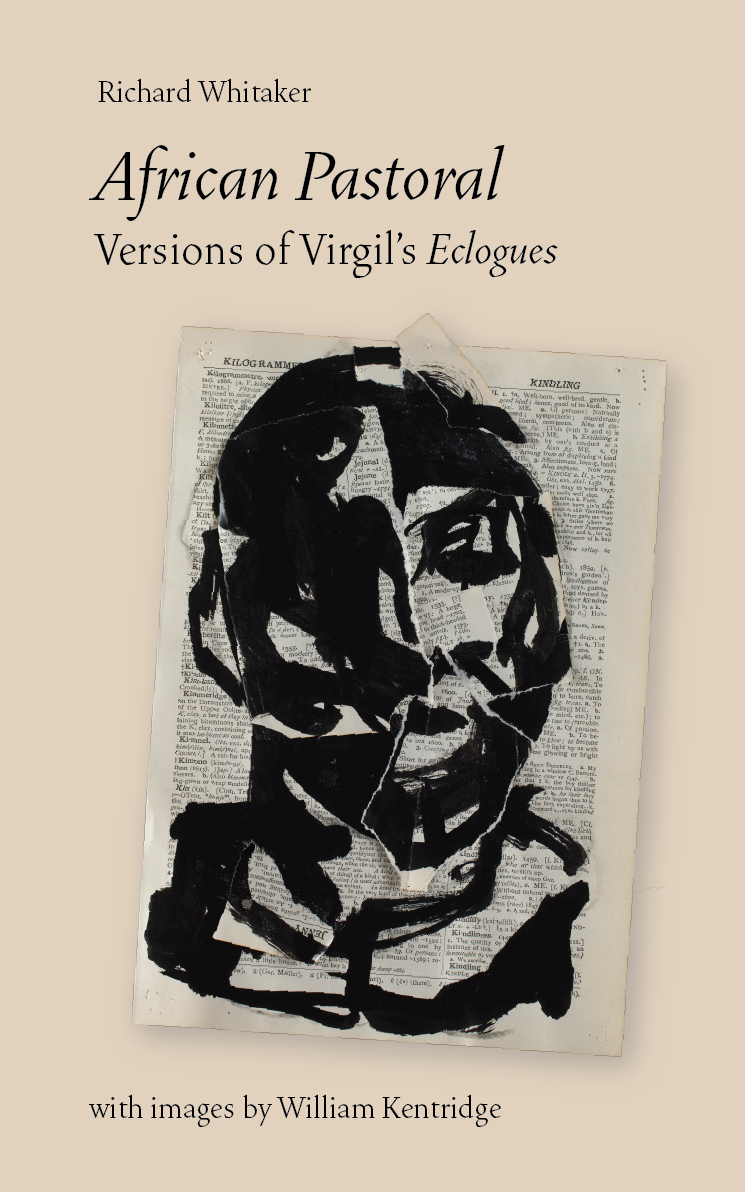
African Pastoral: Versions of Virgil’s Eclogues
 https://doi.org/10.53288/0574.1.00
African Pastoral: Versions of Virgil’s Eclogues presents a fresh and unexpected version of the ten pastoral poems that comprise the Eclogues of Virgil (70–19 BCE). Although these poems focus on the lives of shepherds and goatherds, Virgil makes their seemingly circumscribed existence a mirror of the wider world, a world that is both his and ours. The Eclogues deal with subjects that remain vital in the twenty-first century: erotic passion of many varieties, transformation and metamorphosis, the torments of unhappy love, and the nature and power of poetry (represented by different kinds of pastoral song). With striking originality, Virgil also allowed contemporary power politics to erupt into the world of his herders and small-scale farmers, as they face confiscation of their grazing lands and fields.
South African classicist and translator Richard Whitaker has produced eminently fluent and creative versions of Virgil’s Eclogues. He reimagines the poems in an African landscape and evokes the troubled history of land dispossession in southern Africa, introducing local equivalents for much of Virgil’s Mediterranean flora and fauna and making frequent use of words drawn from indigenous languages that have enriched his country’s variety of English.
African Pastoral includes stunning images by South African artist William Kentridge, which interact with the versions of Virgilian pastoral in multiple ways, complementing and illuminating the poems, as well as raising points of contrast and difference between ancient and modern contexts.
Unvoicing Migraine: A Study of the Failing Voice
Author: Mariske Broeckmeyer
Earth, Milky Way: punctum books, 2026
https://doi.org/10.53288/0536.1.00
These writings spring from an observation: When migraine arises, the voice fails. It does so on many levels, ranging from a vocal-technical disintegration to migraine-specific symptoms like dysarthria and aphasia, up to the muteness forced upon the sufferer by stigmatization. As a migraine-suffering singer, Mariske Broeckmeyer witnesses and experiences these alterations. Frequently, routinely, and almost faithfully, she retreats to the blackened bedroom when migraine manifests. Lying in silence, she notices how little of her vocal instrument remains intact and how distorted our relations become under these circumstances. Migraine mutes—it occupies the body and leaves muscles, lungs, larynx, and tongue under its command. In the attempt to describe these sufferings, Broeckmeyer has indeed stammered and fallen silent, unable to name the pain. But could it be that this failure holds some sort of potential? What might vocal failure reveal about the nature of the voice?
To these questions, Unvoicing Migraine lends an ear. Shuttling between theoretical findings and artistic practice, the book turns to concepts provided by voice theory, disability studies, and queer theory to engage in an artistic research that studies the devocalizing impact of migraine. The book also attempts to redefine the artistic practice of a singer, the author, when her vocal apparatus falters: it questions the singer’s relation to the stage and challenges the boundaries of performance. These aspects of vocality were not merely approached through an autotheoretical discourse, but through the creation of music and sound art that capture the failing voice and amplify it. Ultimately, Unvoicing Migraine looks at what lies beyond migraine, and makes note of its consequences and residues: stains the acid left on the carpet that transform into a woolly eye whose gaze morphs into a mouth that raves in a language we cannot always understand, but which Broeckmeyer transforms into migraine opera.
My 1980s Gayboy Playlist

Author: Arved Ashby
Earth, Milky Way: punctum books, 2026
https://doi.org/10.53288/0535.1.00
In this remarkably intimate book, My 1980s Gayboy Playlist, award-winning music writer Arved Ashby muses over pieces that impacted his sexual and musical awakenings as a troubled gay adolescent—pieces by Tchaikovsky, Chopin, Beethoven, Anton Bruckner, Alban Berg, Prince, Kurt Cobain, and Tom Petty.
Ashby shares memories both intimate and far-ranging, but My 1980s Gayboy Playlist is not a memoir. Instead of trying to amplify an outwardly uneventful life, the author reengages with and renegotiates eight still-simmering touchpoints—some old musical flames, a few abusive relationships among them. Ashby focuses on desire as it spilled messily across different avenues of expression, seeking connections between erotic experience and musical passion.
For Ashby, as a high school student in a small, rural Midwestern town in the early 1980s, choosing Alban Berg records over Van Halen counted as a perversion. When he recognized Tchaikovsky’s melodic fixations and Prince’s and Chopin’s musical fires, he better understood his own kinks. As an inadequate piano student and a shy virgin on tricyclic psych meds, his lack of physical success taught him the limitations of the body but also showed the capaciousness of queer failure.
It was music that showed him how queerness insists on misappropriation, mishearing, and reading against the grain. Musicality, like sexual expression, amounts to a kind of role-playing— involving penetration and violation of identity as well as validations of the self. The author’s queer musical loves have shown him the vital beauty of muck, unreason, and noise, and as an imaginative writer, Ashby offers the liquid self-reflexivity of Proust and the auto-theory provocations of Maggie Nelson, Paul Preciado, and McKenzie Wark. His prose is poetic and playful, and now and again chaotic. He outs himself in and through his work, with humor and radical intimacy.
My 1980s Gayboy Playlist ultimately illuminates what queer theorist Leo Bersani called the gayboy’s inelegant “apprenticeship in desiring.” Ashby’s closest partners growing up were fantasy, seclusion, and music-dependency, and he found his awkward bliss at the start of the era that witnessed AIDS and the rise of the Moral Majority. In Ashby’s early exurban environment, gayness was a thing feared, because unseen and unfathomed, but his musical intimacies made his personal closet endurable. They also helped him to survive his mis-education, to overcome failures of expression, and to craft a sexual awakening into something more rich and more strange.
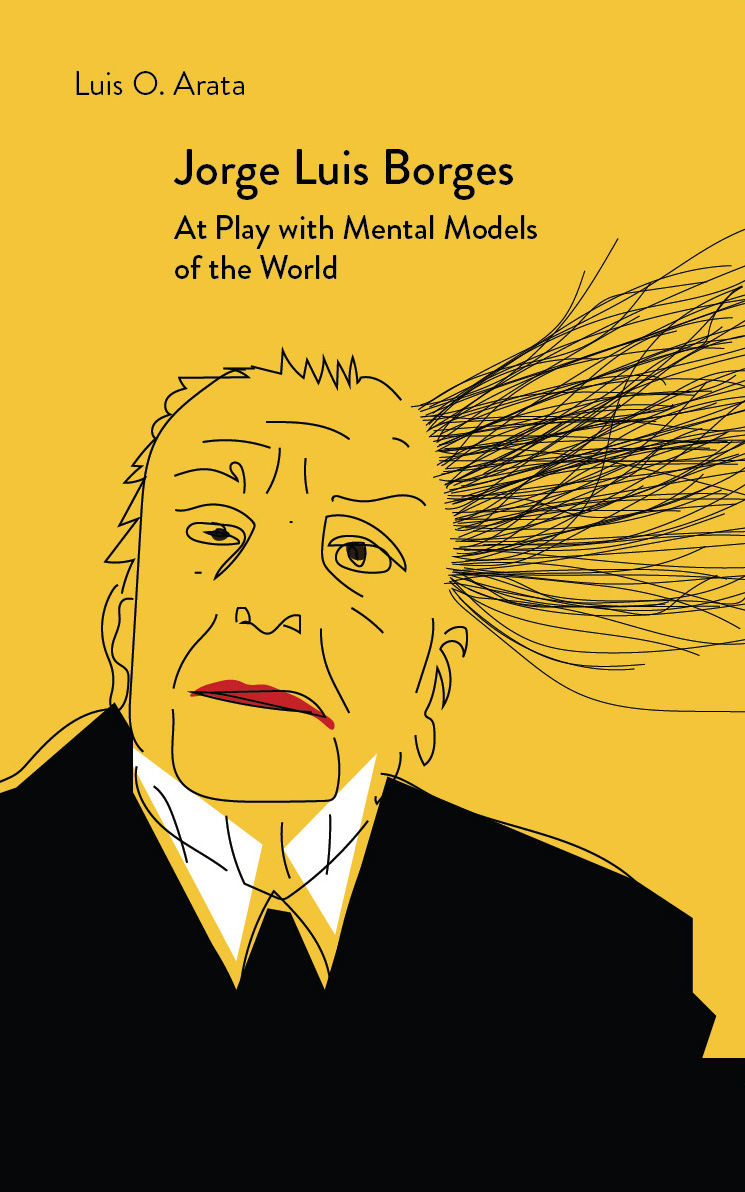
Jorge Luis Borges: At Play with Mental Models of the World
Author: Luis O. Arata
Earth, Milky Way: punctum books, 2026
https://doi.org/10.53288/0542.1.00
Jorge Luis Borges: At Play with Mental Models of the World explores mind-world relations through the creative writings and reflections of the iconic Argentine author, along with insights from corresponding findings in the field of cognitive studies. A selection of representative works—stories, poems, and essays—illuminates features of the constructive imagination that Borges sets in motion to personally blend mind and world, a venture to which he dedicated his life to the very end. This book is for readers from a broad range of backgrounds, interested in the interactive workings of mind and world through fiction, the imagination, and embodied cognition.
Over the years, Borges playfully created and tinkered with models of the self, time, fiction, reality, history, solitude, and reciprocity, among other cognitive objects. Arata focuses on a selection of representative works of Borges to examine how he modeled and then remodeled, over time, his perceptions of the world and his presence in it. Of particular importance was the onset of blindness halfway through his literary life, which led him to playfully remodel certain aspects of his early views of experiencing the world. There was also his surprising partnership with María Kodama toward the end of his life, when he went from prizing solitude to experiencing a sense of reciprocity hardly felt before. Arata concludes this exploration with a view of Borges’s burial headstone that is in stark contrast to his youthful idea that his death would happen in Buenos Aires, with his vanishing engraved in cold marble. Instead, Borges chose to pass away in Geneva, and was buried next to an earthy, rough headstone engraved simply with what could be seen as his playful final story.
Ultimately, Arata’s book asks, to what extent does the mind shape our perception of the world? Through his work, Borges provides us with a personal, passionate example of how fiction and reality blend to create a multiplicity of striking meanings and his writings trace the poignant human quality of a life devoted to conjuring meaning through the interactions of narrative models that emerge from weaving dreams, memories, observations, reflections, and choices.
July 2026
Malleus Daemonum: The Hammer of Demons
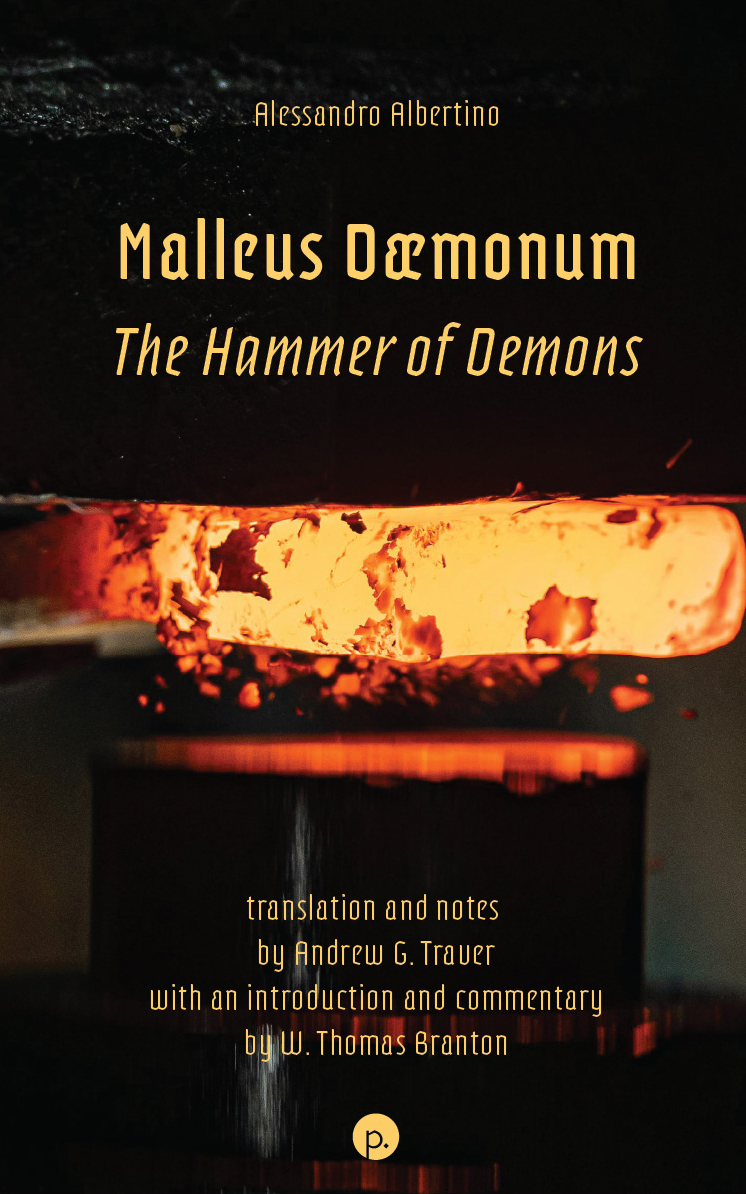
Author: Alessandro Albertino
Translator: Andrew G. Traver
Introduction by: W. Thomas Branton
Earth, Milky Way: punctum books, 2026
https://doi.org/10.53288/0565.1.00
The Malleus Daemonum provides an exciting introduction into the religious world of early modern Italy. It consists of a series of personal exorcisms which the Italian Observant Franciscan Alessandro Albertino composed and which he claims have proven themselves by experience. It bears witness to the end of a period in which priests could freely compose their own exorcisms as a regular part of their pastoral functions.
Albertino’s exorcisms faithfully follow the Passion narrative in the four Gospels designed both to parallel and to empower the Vulgate text. His strategy is to employ the words and instruments used against Christ by his detractors against the demons occupying the possessed individual in order to expel them. Those words and weapons which were once used to torment, harass, and crucify Christ thus become spiritual weapons which the exorcist may use to treat their patient. Albertino introduces each exorcism with an epigram based on Classical mythology followed by litanies, invocations, and prayers, and he also includes a general exorcism to expel demons from specific parts of the body, along with general blessings and prayers to drive out all sorcery and diabolical intervention from particular articles of clothing.
This edition comprises a comprehensive historical and theological introduction, a Latin edition, and the first-ever English translation of The Hammer of Demons. The translation, research, and commentary unveil a long-buried gem of the seventeenth century, offering readers an alluring narrative about the evolving face of the ancient convention of exorcism. More than just a book, this introduction, edition, and translation are an essential contribution to the understanding of the intersection of exorcism, history, and religion in early modern Italy.
The Specter of AIDS

Author: Néstor Perlongher
Translator: Jorge Sánchez Cruz
Afterword by: Gabriel Giorgi
Earth, Milky Way: punctum books, 2026
https://doi.org/10.53288/0548.1.00
The Specter of AIDS is a transdisciplinary text originally written in 1980s Brasil in a time of pandemic emergency. It situates how HIV/AIDS reconfigured intimacy, sexuality, and power while also providing a minoritarian theory of desire lived by dissident sexualities in 1980s Latin America.
Perlongher’s paper exposes a new barometer of life undergirded by medico-scientific reason, religious ideology, and morality — in other words, a re-actualization and intensification of normative reason. In nuanced prose combined with wit, rigorous scholarship, political alertness, and poetics, Perlongher delineates how HIV/AIDS serves as a blueprint for how viral threats shed light on the inequitable unevenness of this world.
Written in Portuguese in 1987 and then published in Spanish in 1988, this translation offers an un/timely reading for the 21st century as it shows how new contaminants threaten national public health’s paradigms of gendered and racialized structures: their borders, bodies, and good comportment.
Autotheory and Its Others
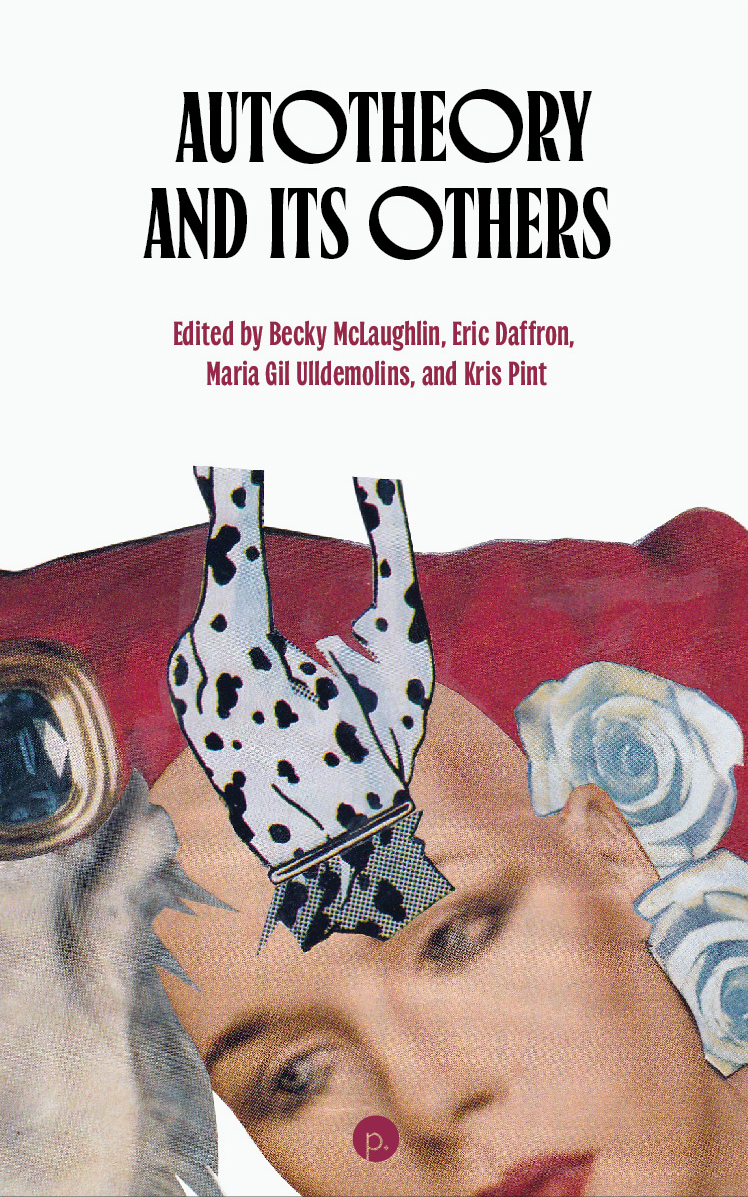
Editor: Becky McLaughlin
Editor: Eric Daffron
Editor: Maria Gil Ulldemolins
Editor: Kris Pint
Earth, Milky Way: punctum books, 2026
https://doi.org/10.53288/0530.1.00
Ever since Maggie Nelson’s Argonauts gave the word fresh currency a decade ago, autotheory has infiltrated scholarly, literary, and artistic practices. Autotheory and Its Others contributes to this nascent metacritical conversation. An inclusive discourse, autotheory embraces its uncanny double, allotheory, and, thus, this collection invites to the table a host of uncanny others: psychoanalysis, queer theory, and crip theory as well as art writing, postcriticism, and autofiction, among other genres and discourses.
Bringing together four editors and thirteen contributors from both sides of the Atlantic, this collection of critical and creative-critical essays grapples with what it means to couple the personal with the theoretical. The volume’s chapters feature geographical settings as far-flung as New Zealand, Iran, and Mississippi and its wide-ranging topics include anecdotal theory and dialogia–theoria, the bodymind and illness, artificial intelligence and experimentation, accident and fantasy, collages and fragments, unlearning and autopractices, unknowing and the unconscious, uncertainty and art writing, narcissus and trauma, kudzu and pedagogy, memory and legend, autofabulation and religion, and lo-fi critique and academia. Ultimately, Autotheory and Its Others showcases this emergent genre’s diversity while also charting its multivalent future directions.
June 2026
Dotawo: A Journal of Nubian Studies 9: Nubian Homescapes

Editor: Anna Lucille Boozer
Editor: Anne M. Jennings
Earth, Milky Way: punctum books, 2026
https://doi.org/10.53288/0578.1.00
Dotawo: A Journal of Nubian Studies offers a platform in which the old meets the new, in which archaeological, papyrological, and philological research into Meroitic, Old Nubian, Coptic, Greek, and Arabic sources confront current investigations in modern anthropology and ethnography, Nilo-Saharan linguistics, and the critical and theoretical approaches of postcolonial and African studies. Dotawo gives a common home to the past, present, and future of one of the richest areas of research in African studies. It offers a crossroads where papyrus can meet the internet, scribes meet critical thinkers, and the promises of growing nations meet the accomplishments of older kingdoms.
The ninth issue of Dotawo takes a long-term perspective on Nubian houses and households to explore the distinctive material, visual, and phenomenological worlds of Nubian homescapes. A “homescape” is an array of features related to the home. It is the socially constructed space of human activity, understood as having spatial, conceptual, and emotional boundaries and delimitations. Contributors to this volume embrace the dichotomy of homescapes, demonstrating how Nubians adapt their homescapes over time and space even while adhering to a core identity. The cross-disciplinary contributions to this volume include sociological, anthropological, archaeological, and linguistic approaches to the topic, as well as photographic essays, artwork, and fiction.
Inner Conflicts
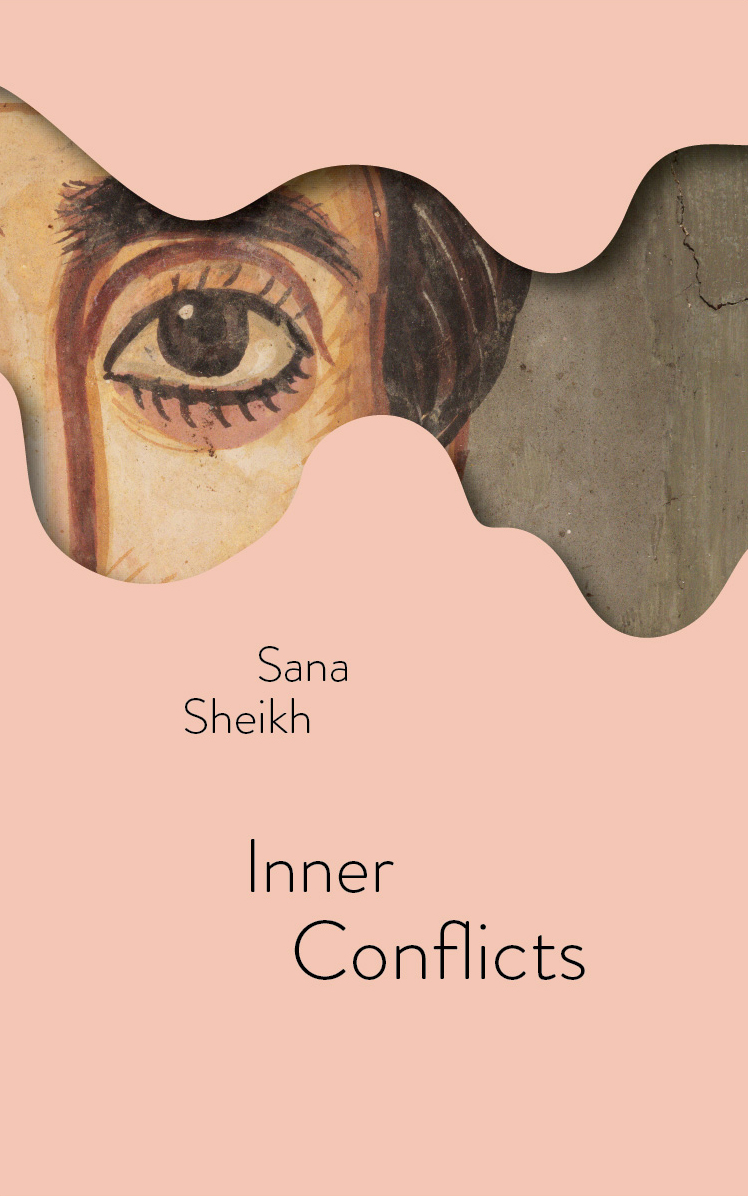
Author: Sana Sheikh
Earth, Milky Way: punctum books, 2026
https://doi.org/10.53288/0464.1.00
What should I do? What is the right thing to do? What do I do when I don’t know what to do?
The difficulty in answering these questions does not come from a lack of knowledge but a deeper problem that requires us to look inward (and outward).
Inner Conflicts is meant to be read in times of upheaval. It traverses jagged terrain, giving voice to the unspoken doubts and contradictions that underlie our dearly held projects. Drawing from psychoanalytic theory, five chapters unpack, process, and – like psychoanalysis – free associate to the fundamental tensions in our lives that refuse resolution. Neither a simple critique nor defense, Inner Conflicts contends that only through acknowledging all parts of the argument within us can we fully attend to the urgencies and particularities of ethical and political life.
Echo Otherwise: A Poetics of Sound and Loss in Ancient and Contemporary Poetry
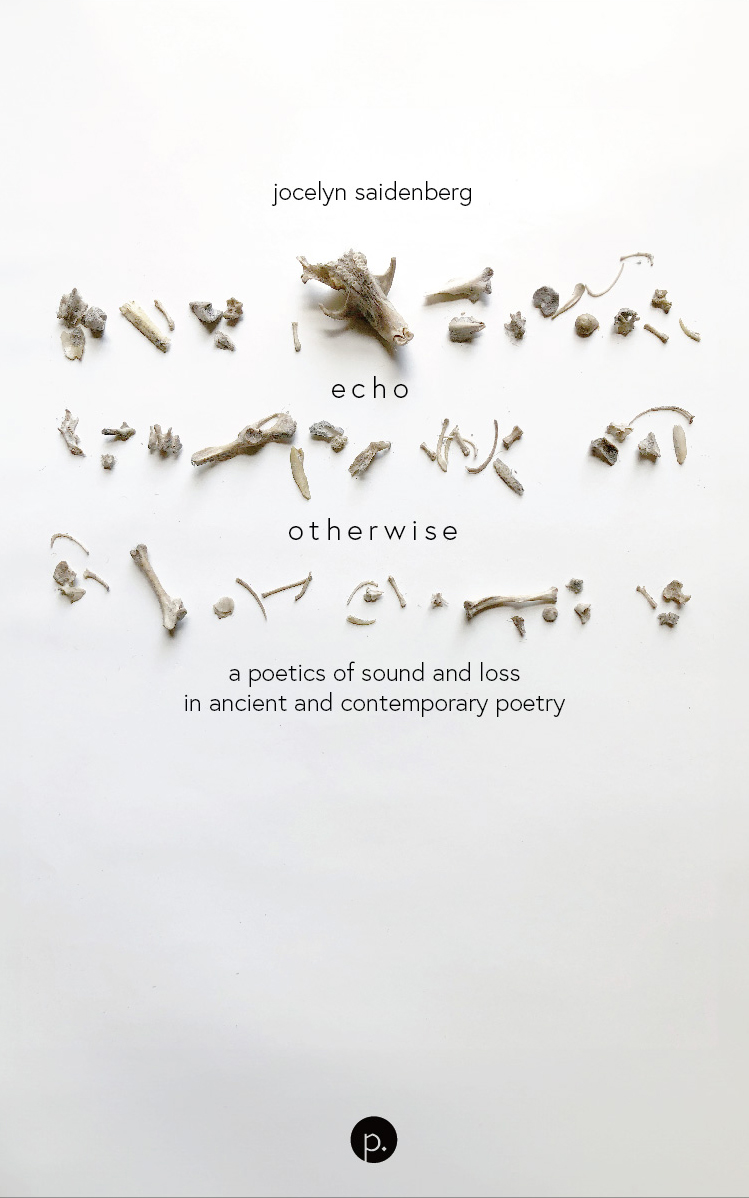
Author: Jocelyn Saidenberg
Earth, Milky Way: punctum books, 2026
https://doi.org/10.53288/0493.1.00
At the heart of this book is a story about reading, about reading and pedagogy, about pedagogy’s readers, about readers who listen, listening while reading, about poems and their sonic materials, about the demands that poetic sounds make on writers and readers, about seduction, about echoes and repetition, about the resounding qualities of poetic matter. How might the inarticulate (or inarticulable) communicate in the sounds of poetry? And how might poetry teach us to attend to what is beyond language or even beyond figuration? Reading for the excluded or absent, that which remains after erasure, might be said to be a hermeneutical commandment. But how might we “read” for the faint echoes of words, the shared, phonic resonances that remain and continue to sound afterwards?
In Echo Otherwise, framed as a series of slow, recursive readerly meditations, Saidenberg sets about attending to these questions by bringing together two writers, Lucretius and Ferdinand de Saussure, whose selected works surprisingly disclose a set of interconnected and overlapping concerns with how sound works and in what sounds and resounds in the universe of poems and atoms, and they are also attentive to what sound tells us about poems and atoms. In addition to her readings of Lucretius and de Saussure on sound in the company of other readers — as reading, for Saidenberg, is a collective affair — there are garden walks in Little Sparta with Robert Glück and sustained engagements with m. nourbeSe philip’s* Zong!,* several works by Saidiya Hartman, and the global pandemic. Ultimately, * Echo Otherwise* attests to the richness of the encounters that transpire in the process of reading and its transformative effects, encouraging forms of relation that would be receptive to and solicitous of unexpected otherness.
The Phonemes

Author: Frances Richard
Introduction by: Ronaldo V. Wilson
Earth, Milky Way: punctum books, 2026
https://doi.org/10.53288/0579.1.00
In The Phonemes, Frances Richard investigates perceptually distinct units of experience, such as sounds, energy surges, and scraps of national and natural history, to create episodes of disruption and dissolution. Organized into sequences that move from seismic notation and wave-form typography to lyric encounters with meteors, snakes, glaciers, and the domestic sublime, the poems break language into its smallest expressive particles and reassemble them at the threshold where sense tips into noise.
Richard’s formal vocabulary is at once scientific and devotional: geological terms collide with fragments of political speech, advertising copy, lullaby, and prayer, while visual scores of nested parentheses, dashes, and radical signs interrupt the page like oscillograph readings of an unstable signal. What emerges is a poetics of phonemic attention, an insistence that a syllable, weather event, or fault line all can carry a full emotional charge and that the task of the poem is to hold open the instant in which raw perception has not yet hardened into meaning.
This title is a second edition, released as part of punctum’s Special Collections project.
May 2026
War Machine
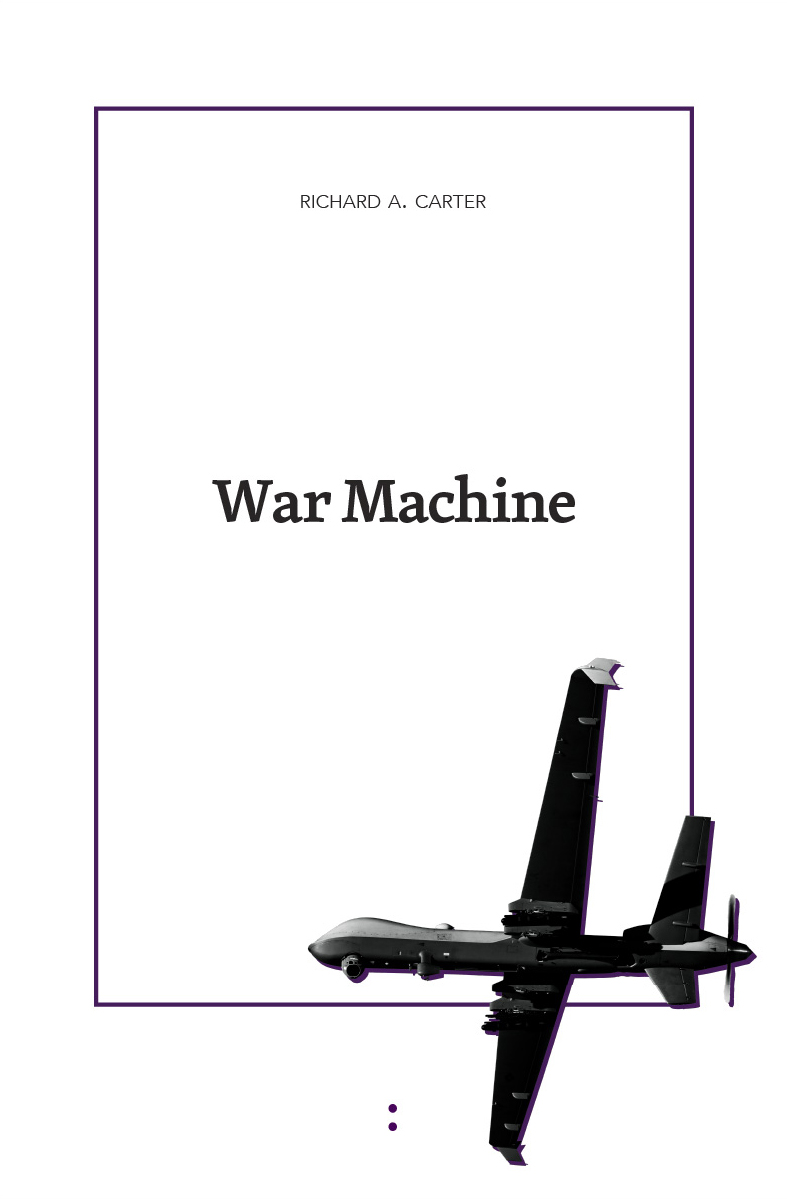
Author: Richard A. Carter
Earth, Milky Way: punctum books, 2026
https://doi.org/10.53288/0564.1.00
War Machine is a speculative sounding of the myriad entanglements of technology, ecology, discourse, politics, and conflict shaping the contemporary environment. Taking the tools of geopolitical competition and control as its formal and conceptual basis—wargame simulations, artificial intelligence, weaponised drones, territorial enclosure, and extractivist economics—War Machine presents a series of digitally simulated conflicts over the most ecologically vulnerable areas of the Earth, using the data gathered to generate hybrid visual poems that stand in for the multitude of political, conceptual, and economic battles that are presently raging across the face of a profoundly endangered planet.
A hybrid work of generative criticism and poetry,* War Machine* depicts the intensive complexities of the present moment through conducting an experimental textual performance, attempting to enfold and perform, rather than simply describe, challenging conjunctions of competing discourses and activities. The resulting stream of outputs and interpretive potentials preclude the ascendency of any “definitive” critical narrative, refusing any straightforward integration with existing canons of worldly diagnosis, but also illustrating opportunities for resistant play and critical-creative possibility within the uncertainty.
The consciously unconventional gesture at the heart of War Machine is in attempt at modelling an adventurous, forward-facing approach, in both thought and practice, that refuses inaction when dealing with otherwise devastating scenarios. It is an approach that acknowledges head-on myriad worldly harms, seemingly insurmountable, while still contributing to the aesthetic, affective, and conceptual foundations from which alternative modes of knowing, being, and meaning are developed and justified.
Lifetimes: A Theory of Timescales and Life Forms
Editor: Helge Jordheim
Editor: Sine Halkjelsvik Bjordal
Earth, Milky Way: punctum books, 2026
https://doi.org/10.53288/0484.1.00
At the beginning of the twenty-first century, many of our most well-known and dependable forms of keeping, managing, and representing time are losing their grasp on the real. Clocks cannot measure how societies speed up, or come to a standstill during crisis, modern historiography is unable to come up with meaningful narratives about mankind as the sixth extinction event, and calendars are insufficient as tools for societal and political change. Lifetimes: A Theory of Timescales and Life Forms presents an alternative framework for studying lives and times, and the relationships between them.
Building on post-war theories of history, as well as several historical sub-disciplines, such as cultural history, history of science, and medical history, Lifetimes integrates approaches from anthropology, game studies, cultural studies, literary studies, critical heritage studies, science & technology studies, and critical time studies. Times are understood as always existing in plural, as embodied and emergent—in things, in assemblages of things, and in the relations between things. Among them are the lives of humans, but also the lives of viruses, plants, animals, rocks, computers, nations, concepts, policies, technologies, infrastructures, etc.
Lifetimes explores theoretical foundations while at the same time developing them through case studies in individual chapters. The result is a bottom-up theory of temporal multiplicity, conceptually and theoretically open enough to be productive across various academic disciplines. Rather than discussing how different disciplines relate to time, the authors in this edited collection present a theoretically sustained, empirically diverse range of cases, in which times in plural become politically and historically salient. Out of these case studies a new theory emerges: a theory of lifetimes.
April 2026
Gazing at the Puerto Rican Anthropological Landscape: The “Natives” Look Far and Wide
Editor: Marisol Ramos
Editor: Manuel Valdés Pizzini
Earth, Milky Way: punctum books, 2026
https://doi.org/10.53288/0540.1.00
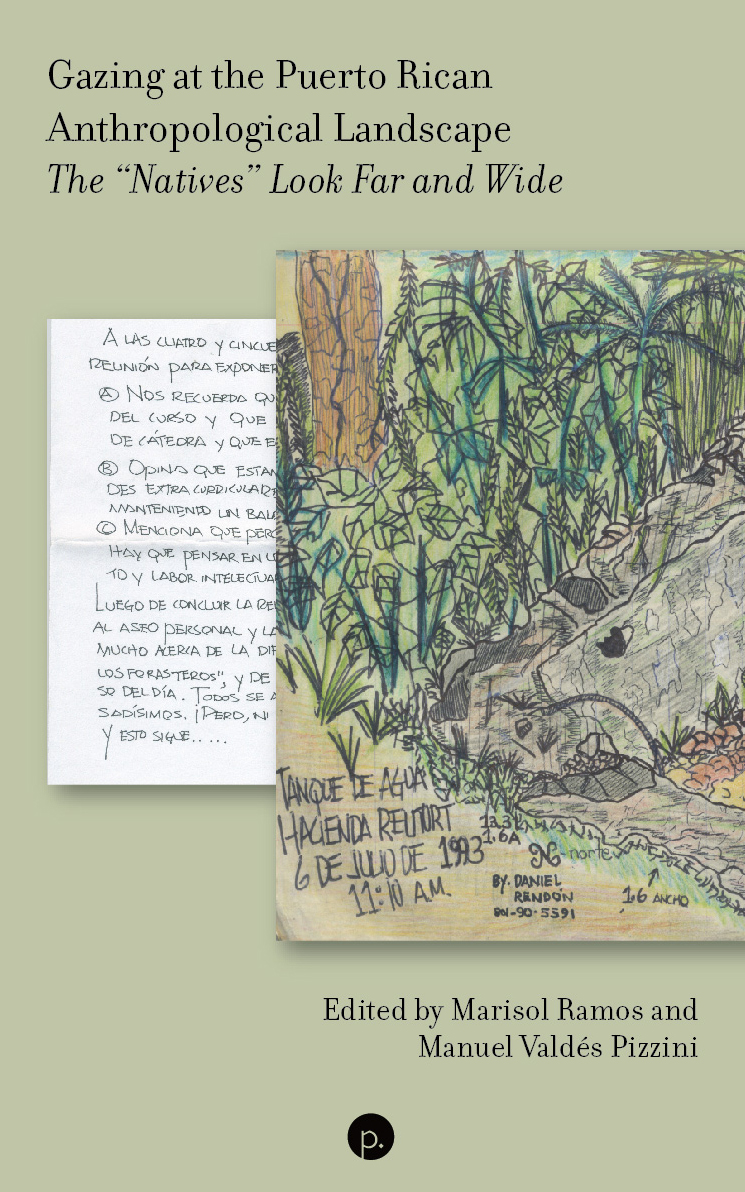
Before World War II, most anthropological research in Puerto Rico was led by US anthropologists. The most famous project, The People of Puerto Rico, was directed by American anthropologist Julian Steward and launched the career of renowned scholars such as Sidney Mintz and Eric Wolf. Gazing at the Puerto Rican Anthropological Landscape aims to delineate the development of the post-WWII anthropological field in Puerto Rico by Puerto Rican anthropologists, the so-called “native” anthropologists. The contributors to Gazing at the Puerto Rican Anthropological Landscape deploy the term “native” somewhat ironically, but they also know that who they are affects their positionality vis-à-vis their research subjects. Thus, they retain the term to spark a conversation addressing the complicated feelings that such labels still evoke among non-mainstream anthropologists.
Gazing at the Puerto Rican Anthropological Landscape purposely avoids making Puerto Rico and Puerto Ricans a problem to study and instead focuses on a wide variety of epistemological and methodological questions related to the study of Puerto Rico and Puerto Ricans by “native” anthropologists within local, regional, and global spheres. We posit that the Puerto Rican anthropological landscape transcends the confines of the island of Puerto Rico to encompass its connection and engagement with the larger world, and that it is not limited to the inhabitants of the island of Puerto Rico but embraces members of its diaspora, as well as other groups and ethnicities. On that note, this book seeks to reflect critically on how the academic field of anthropology (research and teaching) in Puerto Rico has evolved, post-WWII, in various engagements with the current debates of contemporary anthropology — theoretical, methodological, socio-cultural, political, and otherwise.
Sonic Detection: Necessary Notes for Art and Performance
Author: Rebecca Collins
Author: Johanna Linsley
Contributions by: Naomi Pearce
Contributions by: Xavier de Sousa
Contributions by: Christina Beatty
Contributions by: Nii Obodai
Research by: Amaara Raheem
Earth, Milky Way: punctum books, 2026
https://doi.org/10.53288/0470.1.00
Sonic Detection is part sonic noir, part performance document, and part critical investigation of listening at the margins for readers interested in prospecting the boundaries of performance studies, sound studies, and interdisciplinary writing.
The book opens with a group of sonic detectives (exact number unknown) who investigate the mystery of an as-yet-unidentified event that leaves traces only in the acoustic atmosphere. This hybrid fiction propels the reader up and down the UK coast and offers overheard fragments from a faded seaside resort, a container shipping port, a former coal-mining town, and the Scottish headquarters for North Sea oil. A heterogeneous collection of texts follows, from creative-critical essays, performance scores, engagement with the archives of earlier sonic detectives (including poet/performance artist Fiona Templeton and the sound art collective Bow Gamelan Ensemble), to a series of dispatches from expert witnesses with their ears to the ground.
Sonic Detection is not so much a monograph as a polygraph, tongue-in-cheek associations with questionable forensic technologies firmly in place. The book emerges from a decade-long collaboration between artists Rebecca Collins and Johanna Linsley, who used eavesdropping as an expanded creative methodology. The project began as a series of hyper-local, community-based performance works in coastal locations in the UK (from Bournemouth to Aberdeen) and grew into an international, multi-disciplinary life work devoted to an ongoing, organized curiosity. Sonic detectives hold open a collective sonorous space. They are the embodiment of the phenomenophile, lingering longer in listening.
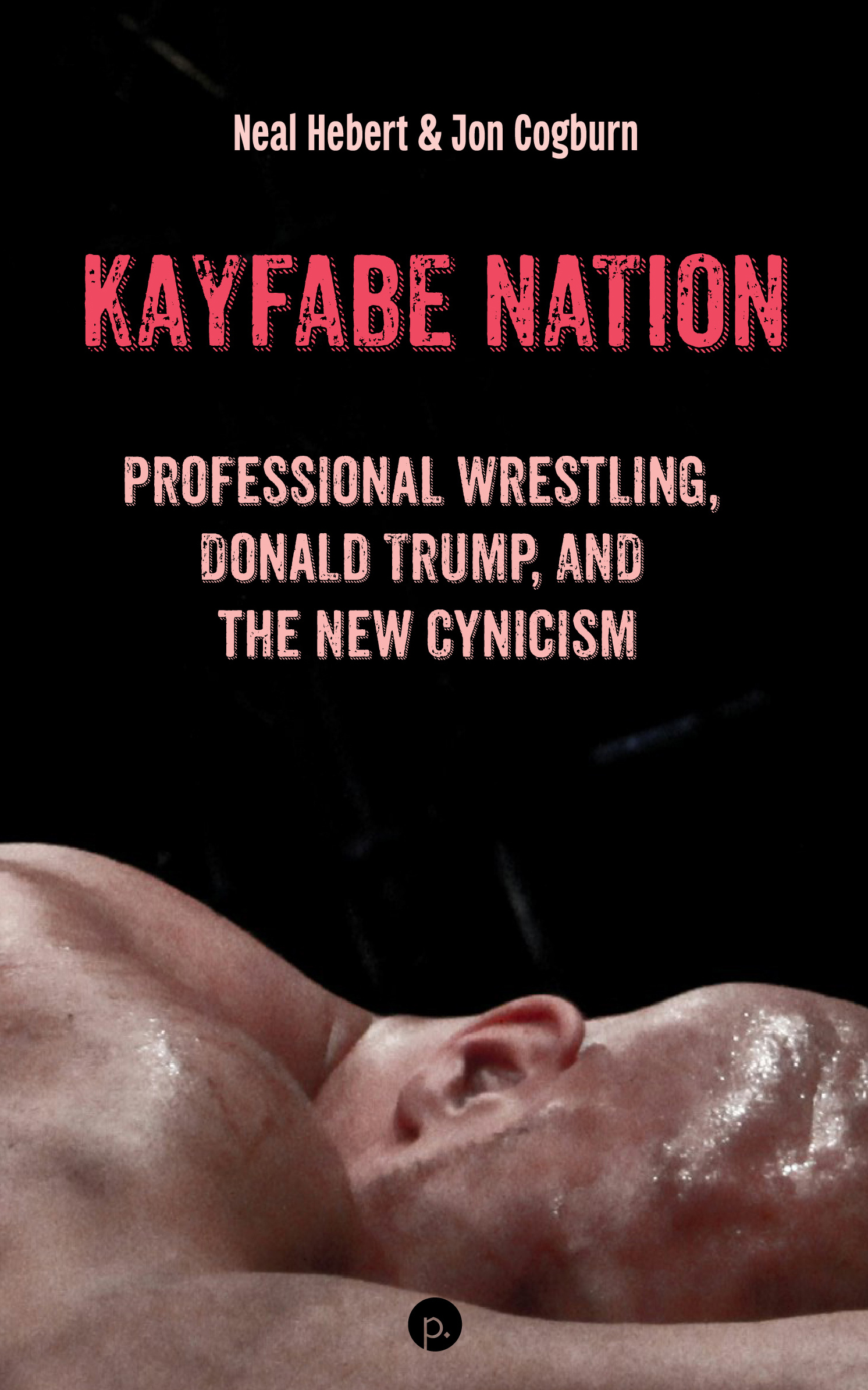
Kayfabe Nation: Professional Wrestling, Donald Trump, and the New Cynicism
Author: Neal Hebert
Author: Jon Cogburn
Earth, Milky Way: punctum books, 2026
https://doi.org/10.53288/0563.1.00
What do a pudgy, orange autocrat, and pumped-up men in tights have in common? The connections, while profound, all rest on specific strategies employed by World Wrestling Entertainment during the early 2000s (known as WWE’s “Attitude Era”) when Donald Trump was centrally involved with the promotion of WWE. These are: (1) universally breaking kayfabe, the code of people in the industry not to reveal or admit fakery; (2) Vince McMahon (WWE’s CEO at that time) playing a fictional version of himself as someone constantly humiliated in storylines; (3) the vicious affirmation of traditional gender roles through parables of male domination; and (4) telling stories that encourage viewers to ignore the actual material conditions of WWE “superstars” in favor of conspiratorial fictions involving powerful individual actors. In Kayfabe Nation: Professional Wrestling, Donald Trump, and the New Cynicism, Hebert and Cogburn present a trenchant analysis of Attitude Era WWE, showing the extent to which MAGA is just is a function, or symptom, of Trump’s internalization of WWE’s most objectionable tropes.
Neal Hebert and Jon Cogburn’s goal is not to use WWE merely to understand Trumpism and the related autocratic turn in countries as diverse as El-Sisi’s Egypt, Putin’s Russia, Erdogan’s Turkey, Modi’s India, Bolsonaro’s Brazil, Orbán’s Hungary, Netanyahu’s Israel, and of course Trump’s own America. Beyond that, Kayfabe Nation is a defense of truth against the lie that culminates in the widespread adoption of self-defeating conspiracy theories among the constituency of the right, as well as against the idea, popular in corrupted center-left parties across the planet that political success comes down to adopting better rhetorical strategies, strategies that exist in part to cover over their abandonment of New Deal and socialist ideologies where the material conditions of their constituencies would actually improve.
March 2026
Works for Works, Book 2: “No Rights”
<img src=“https://books.punctumbooks.com/10.53288/0512.1.00_frontcover.jpg” alt=“cover for Works for Works, Book 2:”No Rights”” width=“300”/>
Author: Gavin Keeney
Earth, Milky Way: punctum books, 2026
https://doi.org/10.53288/0512.1.00
Works for Works, Book 2: “No Rights,” privileges works-based agency (praxis) in literary-artistic scholarship. The principal focus of the Franciscan-inspired embrace of a “no rights” status for works of literary-artistic scholarship is toward freeing both author and works from forms of technocratic determinism and neo-utilitarianism associated with regimes of intellectual property rights law and platform cultures. Engaging, and then dispensing with, the concept of “the artistic exception,” a holdover from modernist justifications for art in/for itself, Works for Works nonetheless restores the primacy of the work itself through disconnecting author and work toward a transfiguration of both author and work and the substantiation of a new ecosystem for radical works of artistic-critical inquiry.
Works for Works, Book 2: “No Rights,” follows upon Works for Works, Book 1: Useless Beauty (2022), a structuralist-inspired survey and exposé of the immanentist paradox artist-scholars inhabit in the post-contemporary transition from modernist and post-modernist reflexivity to forms of cultural production that favor no singular raison d’être nor socio-cultural, socio-economic, or socio-political bias.
Red Lives: Our Years in the U.S. Communist Party (1950–2000), Vol. 1: Coming of Age in the Communist and Labor Movements
Editor: Jay Schaffner
Editor: Paul Friedman
Editor: Cindy Hawes
Editor: Geoffrey Jacques
Editor: Timothy Johnson
Editor: Carol Pittman
Editor: Donna Ristorucci
Editor: Daniel Rosenberg
Editor: Jackie Saindon
Foreword by: Robin D.G. Kelley
Earth, Milky Way: punctum books, 2026
https://doi.org/10.53288/0455.1.00
Red Lives: Our Years in the US Communist Party (1950–2000) is the first collection of historical analyses and reminiscences by members of the Communist Party USA (CPUSA) and the Communist youth movement in the US from the 1950s through the 1990s. The nearly fifty first-person testimonies bring to life a missing chapter in the history of US radicalism and demonstrate the influence of the post–World War II generation of Communists on social justice movements.
Most histories of US Communism end in 1956 when Red Lives just begins, when McCarthyism was on its final legs, the Civil Rights Movement was sweeping the American South and the whole country, the student movement was taking its first breaths, and a new generation of young people were seeking out socialists, communists, and the Communist Party in order to craft a radical, anti-establishment politics. At a time when the launching of Sputnik, the Cuban Revolution, other revolutions sweeping Africa, and the example of the Vietnamese people fighting for their freedom and independence were inspiring the world, one-third of the world was also socialist, led by the Soviet Union and China. The time was propitious for a new generation in the US to also be seeking out, and joining, the CPUSA. This first volume of Red Lives, Coming of Age in the Communist and Labor Movements, brings the stories of that generation to the forefront of American history at a time when narratives of resistance are more needed than ever before.
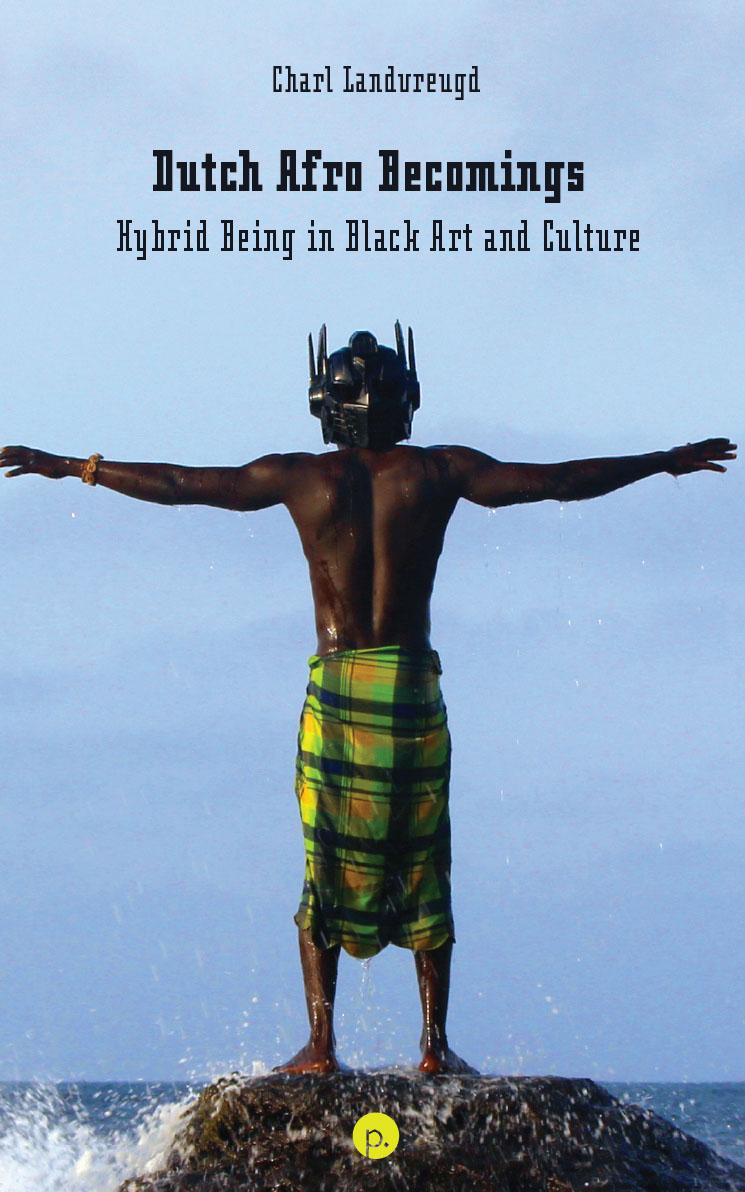
Dutch Afro Becomings: Hybrid Being in Black Art and Culture
Author: Charl Landvreugd
Earth, Milky Way: punctum books, 2026
https://doi.org/10.53288/0537.1.00
In Dutch Afro Becomings, artist, curator, and researcher Charl Landvreugd argues that we do not yet have a language to understand Dutch Afro-ness, and that it is insufficient to rely on the discourses developed in African American, Black British, or Caribbean cultural theory alone. This critical monograph on continental European Black art and cultural history articulates the specificity of Dutch Afro-ness and the way that Blackness has been translated and (mis)understood across multiple decades of cultural policy, while also providing an incisive analysis of the Dutch state’s aim to showcase “diversity” in a way that is comfortable to the white cultural class, without ever addressing issues of racism or race.
Simultaneously, Landvreugd traces how recent generations of artists are effectively constructing a new visual language to name their Dutch Afro-ness by deepening the way their being is shaped across multiple cultural identities and national histories. These time travelers and wanderers are the Wakaman: cultural workers that embrace their hybridity and multiplicity and have defined, on their own terms and through their own words, their nativity within the Dutch art scene.
Dutch Afro Becomings is a key theoretical and art-historical work, as an introduction to both different international genealogies of Black arts and culture and to the different movements that shaped the specificity of Dutch Afro artists in particular.
February 2026
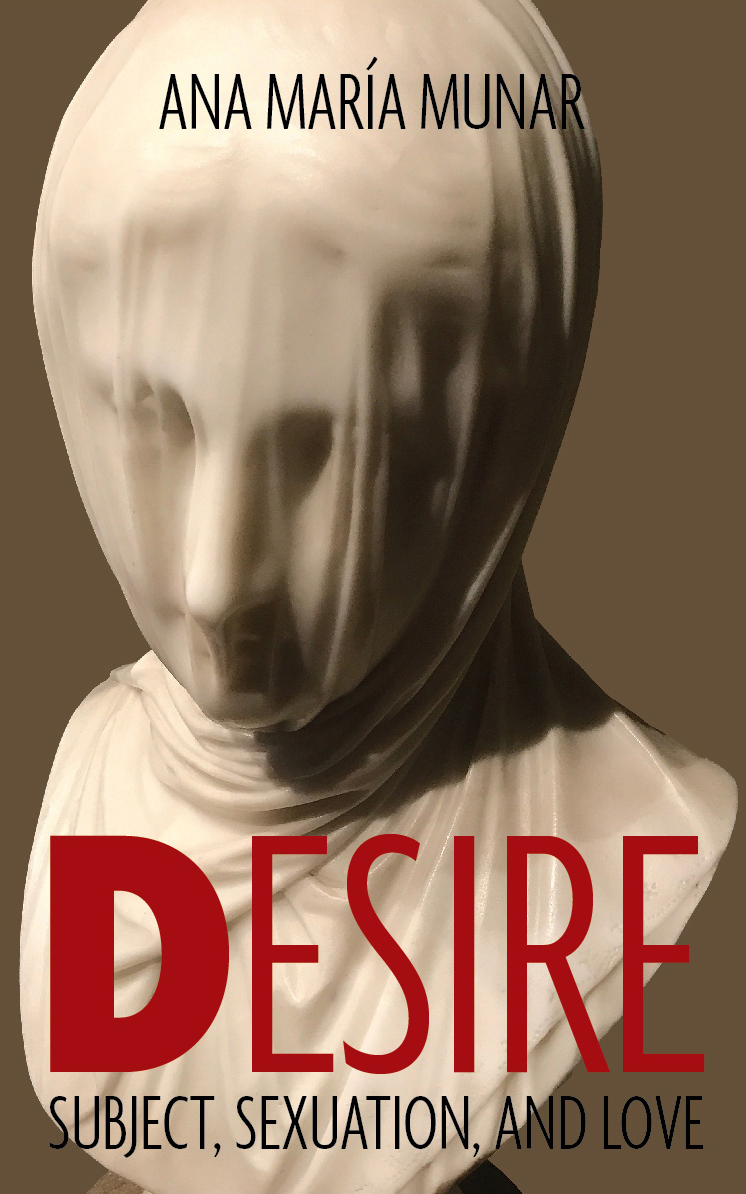
Desire: Subject, Sexuation, and Love
Author: Ana María Munar
Earth, Milky Way: punctum books, 2026
https://doi.org/10.53288/0516.1.00
Have you ever wondered what makes you wake up in the morning? Why not just lay down, stay, and eventually disappear? What is the wanting, the energy, and the grace of liveliness? Desire is at the core of liveliness, and this book explains why it is so. Desire is much more than a mere appendix to love, sex, or our craving to have the latest fashion item. It is what allows the most personal and unique expression of each of us.
Desire: Subject, Sexuation, and Love is a work of gratitude to the Lacanian tradition and feminist philosophy. It creatively uses the story of “The Little Mermaid” by H.C. Andersen, as well as art and popular culture to explain the complex landscape of desire and its relation to love and sexuation. Much of the criticism of psychoanalysis from gender studies and poststructuralism is based on a superficial reading of Jacques Lacan, and Munar corrects this, providing in the first half of the book a rigorous and clear analysis of Lacanian subjectification and sexuation, elucidating their relationship to the nature of desire and love, in order to modify overly simplistic and erroneous interpretations of his thinking on desire.
Desire is essayistic and poetic philosophy, drawing upon and playing with psychoanalysis, philosophy, literature, biography, poetry, and art. As the reader enters the second part of the book, the focus on Lacanian theory recedes, opening a space that is more paradoxical and multiple where Munar engages in creative form as an expression of critique, transforming our understandings of desire and love, which always elude us while also always being present.
Imagining What We Don’t Know: Creative Theory and Critical Bodies
Author: Lisa Samuels
Earth, Milky Way: punctum books, 2026
https://doi.org/10.53288/0483.1.00
Bringing together perception, ecology, community, lingual value, and quantum life, Imagining What We Don’t Know: Creative Theory and Critical Bodies presents twenty-four essays and theory poems that blend interpretive neologisms — wild dialectics, distributed centrality, membranism, deformance, bioautography, transplace, soft text, and more — with readings of visionary philosophers and the art and writing of Algeria, Australasia, the Caribbean, Oceania, the UK, and the US.
Committed to experimental ideation and relational ethics, Imagining What We Don’t Know is for art and theory practitioners, philosophy rebels, creative writers, and anyone who relishes thinking about contemporary art, transnational and transdisciplinary life, and how we imagine with language. Imagining What We Don’t Know presents a biblio-architecture of “blurprints” built with theories of the embodied mind that are elemental, entangled, and electrified by the political. This is creative theory, hovering with alterities of art and interpretation and imagining with critical attention.
Corporeal Aesth/ethics: The Body in Bracha L. Ettinger’s Theory and Art
Author: Anna Kisiel
Earth, Milky Way: punctum books, 2026
https://doi.org/10.53288/0499.1.00
Can we think of an ethics that originates in corporeality, and not in codified or symbolic systems? In* Corporeal Aesth/ethics,* the body resurfaces as a central category of Bracha L. Ettinger’s theory and art, as well as an interpretive key that allows us to assume ethical responsibility for an Other who is not abstract, or distant, or total. Ettinger’s matrixial theory, a deeply feminist psycho-analytical system, ventures beyond the models of subjectivity based on separation and lack, and thus it helps us rethink togetherness and our own humanity.
Corporeal Aesth/ethics explores how we become subjects not through a series of cuts, but through an encounter with radical openness, modeled upon the intrauterine/pregnancy period. Even though the theorized encounter relies on caring, carrying, and sharing, it is far from pleasant and safe, as we might assume. Indeed, some of the knowledge communicated in this phase of subjectivity-becoming may turn out to be painful, even traumatic. It is this profoundly corporeal encounter, Kisiel contends, that makes it possible to conceive of the body as a site and source of ethics. Envisioned through the lens of the matrixial, a subject (never alone, always in severality) reaches new modes of intimacy and hospitality, occasioned by our universally shared, originary experience of becoming with-in the maternal body.
A psychoanalyst, theoretician, and feminist, Ettinger is also an artist. Sharing Ettinger’s conviction that “painting and theory are not different aspects that attest to the same thing, but are rather differentiated levels of working-through,” Kisiel maps the entanglements of the (feminine/motherly) body in both dimensions of Ettinger’s work. In five chapters, this book delineates the project of Ettinger’s corporeal aesth/ethics. It contextualizes the matrixial body, analyzes its humanizing potential, and proposes dialogues of Ettinger’s work with feminism, theology, and Holocaust studies.
January 2026
Urban Liquefaction: Rethinking the Relationship between Land and Sea
Editor: Cristián Simonetti
Editor: Michel Lussault
Editor: Tim Ingold
Earth, Milky Way: punctum books, 2026
https://doi.org/10.53288/0532.1.00
From classical times until today, cities have been conceived in the western imagination as ideally confined to the fixities of the land, a space defined in opposition to the fluxes of the sea. Whereas solid land afforded a durable platform for the establishment of property and citizenship, the fluid sea allowed markets—isolated within the secure boundaries of cities—to be connected across the globe though navigation.
Urban Liquefaction: Rethinking the Relationship between Land and Sea attends to the concurrent tensions between solidity and fluidity, permanence and impermanence, and substance and change that remain at the core of the western intellectual tradition, often dividing what is perceived as social from what is perceived as natural in life. Sea level rise poses unprecedented threats to this oppositional relationship, forcing us to reconsider the tension between solidity and fluidity in the design of the built environment. Nearly ten percent of all major cities are likely to be impacted by sea level rise in the coming decades, compromising the necessary infrastructure on which urban life depends. In reality, urban landscapes have been continually in flux, which becomes dramatically visible to urban dwellers mostly in catastrophic events such as earthquakes, tsunamis, alluvions, sinkholes, and, above all, soil liquefaction.
Urban Liquefaction gathers contributions from scholars and practitioners working across continents and fields interested in urban life in (and after) the Anthropocene, including anthropology, archaeology, art, architecture, design, human geography, and science studies, to open up an inquiry into these categorical tensions and to speculate on alternative futures for the built environment.
The Case of California
Author: Laurence A. Rickels
Earth, Milky Way: punctum books, 2026
https://doi.org/10.53288/0577.1.00
Focusing on the changing image of the West Coast through such varied social and cultural artifacts as bodybuilding, group therapy, suicide cults, Marilyn Monroe, milk-carton images of missing children, orgies, Mickey Mouse, zombies, teenage slang, shock therapy, and surf music, The Case of California offers a dizzying psycho-history of the twentieth century as crystallized in the symbolic configuration and “case” of California, which case is articulated in relation to German modernism, National Socialism, and Freudian psychoanalysis. As Laurence Rickels writes, “on the personalizable level or label, California is a death cult; on the social, outward, happy-face level, it distributes pleasure via sadomasochism, the adolescent group, or friendship.”
Ultimately, The Case of California excavates the places “California” occupies as concept or placeholder within Freudian psychoanalysis and such systems as the Frankfurt School, East Coast psychoanalysis, and deconstruction. To excavate the full range of “California,” one must apply pressure to a series of adjacent (and often equally marginal or missing) concepts, including group and adolescent psychology, female sexuality, the haunting of music and of mass media at large, the charge of child abuse, and a certain convergence of religious and hysterical conversion.
This publication was originally published by University of Minnesota Press in 1991, and is now being released as a new print and open-access edition as part of punctum’s Special Collections initiative.
December 2025
“FOLLOW THE PERSON”: Archival Encounters
<img src=“https://books.punctumbooks.com/10.53288/0395.1.00_frontcover.jpg” alt=“cover for”FOLLOW THE PERSON”: Archival Encounters” width=“300”/>
Author: Ammiel Alcalay
Introduction by: Miriam Nichols
Earth, Milky Way: punctum books, 2025
https://doi.org/10.53288/0395.1.00
Poet, novelist, translator, scholar, and critical essayist extraordinaire, Ammiel Alcalay’s intrepid work has always moved across geographic, chronological, political, and linguistic borders. “FOLLOW THE PERSON”: Archival Encounters gathers a dizzying array of texts by Alcalay written over the past fifteen years, all of them having something to do with archival materials. In Alcalay’s case, however, these archives range from more traditional, institutionally-held materials and personal collections to the use of his own experiences and memories as sources for redrawing cultural maps that have too long been divided along sectarian lines of one kind or another.
Moving from the Beats and the Black Arts Movement to the Middle East, “FOLLOW THE PERSON” recalibrates our sense of living history while offering new possibilities for encounters that have been relegated to oblivion or never even imagined. Culled from a variety of eclectic sources and contexts, encountering these essays together offers a completely different experience of Alcalay’s essays, one that argues for a methodology based on minutely recorded events and historical contexts, and for necessary human and cultural encounters that provide models for a new, reinvigorated critical vocabulary.
As Miriam Nichols writes in her Introduction, “Follow the tenuous threads in this collection of writings and you may end up at the looted National Museum in Baghdad during the American invasion, or in the Hoover Institute at Stanford University where most Iraqi state archives wound up. You may find yourself at Bashcharshiya, the market in Sarajevo during the Bosnian war, or in Palestine, on May 14, 1948. Maybe, if you are keen, you will pick up the thread that leads to 17th-century colonial Massachusetts, or perhaps you will stay in New York, rummaging through garbage cans with Diane di Prima, looking for journals and letters tossed out by a lover.” Whichever path you take, you will find multiple worlds, all rendered by Alcalay with light and compassion.
November 2025
Voix de Glace / Voice of Ice

Author: Alta Ifland
Introduction by: John Taylor
Earth, Milky Way: punctum books, 2025
https://doi.org/10.53288/0589.1.00
Voix de Glace/Voice of Ice is a series of prose poems about the estranged self living outside of one’s native land and away from one’s native tongue. Romanian poet Alta Ifland writes first in French, then translates her work into English, before returning to the original French for further revisions, a process of linguistic reconciliation as much as translation.
Published in a bilingual, French–English edition, Ifland repeatedly turns to remembered images of her unnamed homeland to animate her unfamiliar home, creating, what poet Gary Young calls “a brilliant collection of prose poems document[ing] the quest for a coherent self, an authentic identity born out of the chaos of language and history.” He continues, “Ifland’s poems trace a radical process of de-creation—dismemberment of the body, dissolution of the ego, abandonment of the self—and the reinvention of a new identity, purified by the acid of tears. This new creation—tentative and rarified, ‘a child’s body of light’—earns a tenuous existence, but it proves to be enough to withstand the omnipresent threat of oblivion.”
Voix de Glace/Voice of Ice won the 2008 Prix Louis Guillaume du Poème en Prose/Louis Guillaume Prize for Prose Poetry.
This title is a second revised and expanded edition with a new introduction by John Taylor, released as part of punctum’s Special Collections project.
Perceptron
Author: James E. Dobson
Author: Rena J. Mosteirin
Earth, Milky Way: punctum books, 2025
https://doi.org/10.53288/0408.1.00
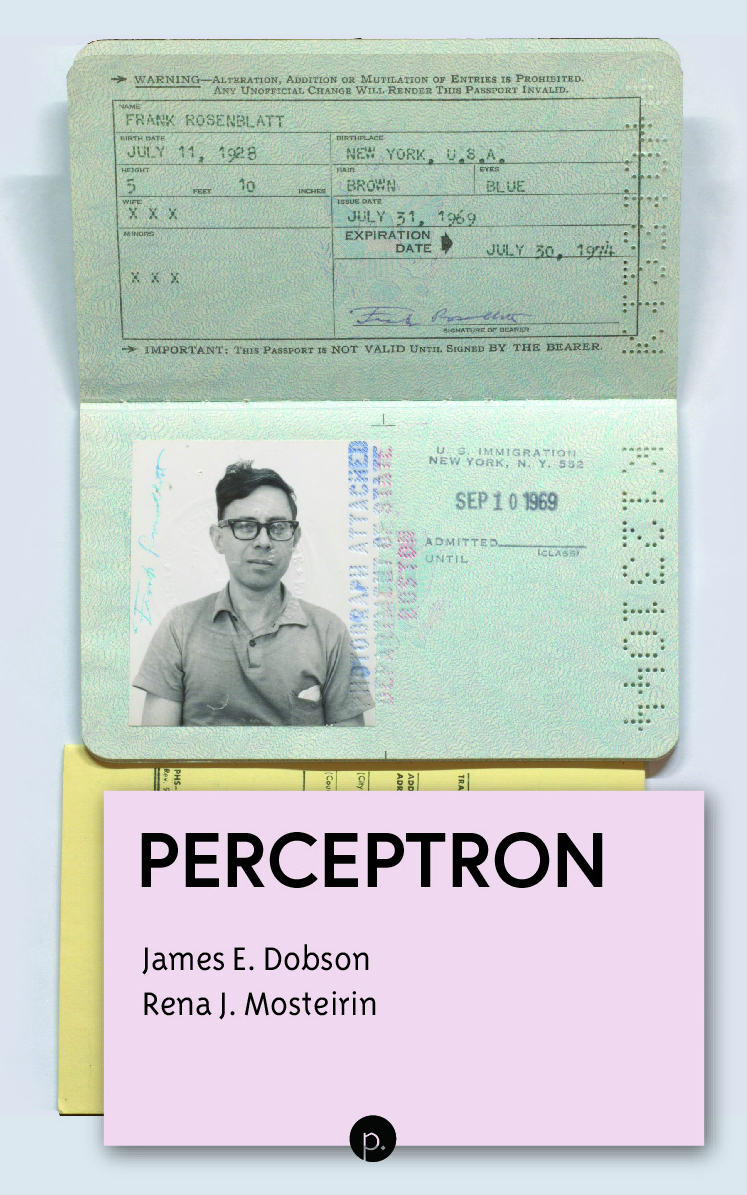
Perceptron is a work of experimental poetry and a critical biographical reading of Frank Rosenblatt (1928–1971) and his 1957 invention, the Perceptron. The Perceptron was the first widely publicized and used machine learning device and the origin of much contemporary neural network technology. Rosenblatt was a psychologist, a computer engineer, a musician, an amateur astronomer, a sailor, and a poet. The Perceptron was born from an interdisciplinary mix of ideas and was so far ahead of its time that it was widely misunderstood by other scientists and the public.
This mechanical invention, imagined as an alternative to general purpose digital computers, and its algorithmic implementation as a simulation of the device was deeply rooted in mid-twentieth-century neuroscience and psychological theories of behavior. Introduced to the world by one newspaper under the headline “Shades of Frankenstein!” in 1958, following a public demonstration in Maryland sponsored by the US Navy, the Perceptron was a radical new approach to designing computer systems. What made it different was its design as a simplified model of animal vision systems. The Perceptron could perform pattern recognition and matching from a collection of simple visual objects. It was innovative and impressive, but it was also constantly oversold by its financial supporters, the press, and by its inventor.
Perceptron traces, contextualizes, and celebrates the ideas that would become embedded in this early thinking machine and that animated the excitement and promise that would eventually turn to frustration and failure during Rosenblatt’s tragically short lifetime.
October 2025
The Negated Institution: Report from a Psychiatric Hospital
Editor: Franco Basaglia
Translator: John Foot
Earth, Milky Way: punctum books, 2025
https://doi.org/10.53288/0513.1.00
The Negated Institution: Report from a Psychiatric Hospital was first published in 1968 in Italian and caused an immediate sensation. It was an instant bestseller and was translated into numerous languages, but never into English. Edited by the Venetian psychiatrist Franco Basaglia, the book is a collection of writings, interviews, and debates which tell the story of the transformation of the Psychiatric Hospital in Gorizia, on the northeast border of Italy, into an open and “negated” institution. This story of an historically unique process of de-institutionalization—with the elimination of walls and barriers, the humanization of the hospital, the introduction of debates and meetings, the unlocking of wards, and the questioning of the very basis of all psychiatric hospitals—struck a nerve with the student and worker movements of 1968. It also gave a voice to the patients themselves, telling their stories of violence but also of liberation.
The Negated Institution was highly sensitive to the contradictions of this project of opening up and negation, and called for the abolition of the entire system of psychiatric asylums, as well as new ways of understanding and contextualising mental illness and mental health. It led to debates in many countries within and outside of psychiatry and played a part in the 1978 “Basaglia law,” which eventually closed down the entire psychiatric hospital system in Italy—the first example of such total closure in the world, which endures to our contemporary moment.
This is the first translation into English of this seminal text. The translator, John Foot, is an expert in the life and work of Franco Basaglia and has added notes and a critical introduction.
Ontohackers: Radical Movement Philosophy in the Age of Extinctions and Algorithms, Part III: Metahistories of Movement: Philosophies in Becoming
Author: Jaym*/Jaime del Val
Earth, Milky Way: punctum books, 2025
https://doi.org/10.53288/0545.1.00
Ontohackers redefines what movement, worlds, and bodies are through the sense of proprioception reconceptualized as formless fluctuation field, a movement matrix that is itself also thought, and which underlies all life forms and fields, including the inorganic. Our worlds are made of endless such entangled fields n-folding in neverending variation or enferance. The current planetary crisis has emerged due to an accidental evolutionary alignment, narrowing, and impoverishment of that matrix’s indeterminacy, that appeared gradually and eventually with bipedalism, and which created an imbalance between the larger proprioceptive field and its brain, and made the atrophied body extend itself technically in geometric fields gradually covering the planet, along with its fears, with disastrous consequences that are unleashing an unprecedented type of mass extinction and species suicide.
The reply to this crisis – which is urgently due if we are to reduce even slightly the collapse coming over the next decades – is in recovering a lost sensorimotor plasticity which is also cognitive, affective, and relational plasticity, through developing movement technes for cultivating Body Intelligence (BI), reversing and taking elsewhere the failed evolution culminating in AI, stepping down from humanist supremacist pedestals, undoing our dependency upon unsustainable killing machines of sedentary consumerism that impoverish experience, stopping the reproduction of a species that has become plague (by reversing heteronormative reproductive dogmas till we reach preagricultural population levels), and recovering the joys of moving with the world, in symbiotic mutation, towards unprecedented evolutionary variations: this is our cosmic responsibility for all life on Earth.
The book’s structure expresses Enferance Theory with regard to how processes of becoming have a triple movement: an incipiency unfolding the field (Part I), a condensation-expansion where the field acquires full consistency (Part II), and a resonance or memory of the field relating to other fields (Part III).
Part III provides a critical history of (movement) philosophies, exposing the rise of the mechanistic vision as dominant anomaly emerging from a variety of other older proposals which have continued to exist in the background, returning more strongly since the 19th century, while exposing the limitations of recent attempts to free movement from the metaphysical tradition, which the book associates to the rise of human supremacism and its associated mass extinction cycle. The book proposes that movement is the core hidden motif of philosophy and diagnoses philosophies following a metaphilosophical and metaformative methodology that considers the perceptual–kinetic frames and biases underlying them. It is both a sketch for future expansion and an appendix to the previous two volumes, which grounds Radical Movement Philosophy in a critical revision of the literature, exposing the differences, while undoing some errors, and rescuing philosophies like that of many Presocratics from the misreading stemming from Aristotle. Hereby a shift from philosophia to philokinesia is proposed, toward a thinking of the body in motion, reversing philosophy from a tool of human supremacism to an undoing of it and a regeneration of movement diversification – and with it life – in the Biosphere.
Crossings: Migrant Knowledges, Migrant Forms
Editor: Natalya Din-Kariuki
Editor: Subha Mukherji
Editor: Rowan Williams
Earth, Milky Way: punctum books, 2025
https://doi.org/10.53288/0417.1.00
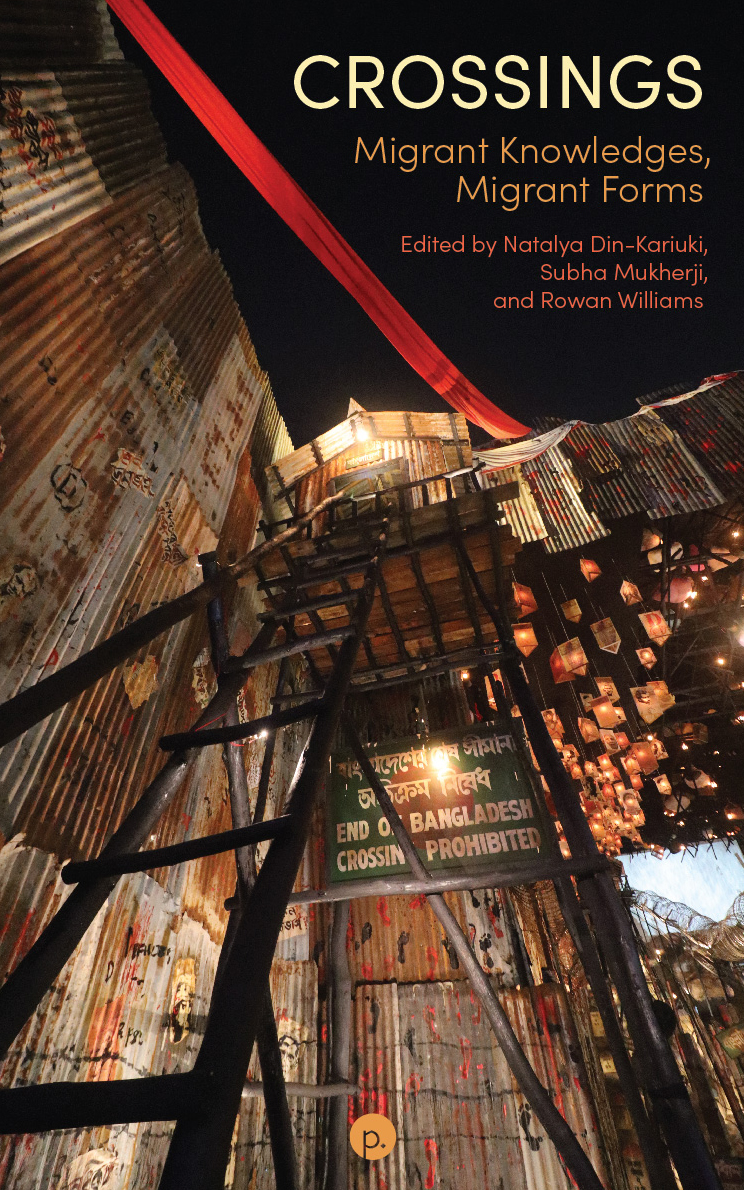
Crossings: Migrant Knowledges, Migrant Forms brings together activists, artists, scholars, and migrants with diverse histories to explore what the experience of migration does with, and to, knowledge, and how its own ways of knowing find expressive form. As the volume’s authors think about physical and imaginative crossings, and the traversals and transactions of knowledge they entail, the book itself crosses and complicates disciplinary and formal boundaries and the barriers between critical and creative intervention. Crucially, it brings together voices and forms emerging out of the experience of dislocation with responses to the encounters it generates.
The volume’s discussions begin in the early modern world, and move freely across periods to dwell on the urgent experience of migrancy in our own times, while also responding to an urgent need to connect the local with the global experience of migrant knowledge and migrant aesthetics. Crossings stakes the claim that creative art, backed by humanities-based thinking, can meet the imaginative and ethical demands that the unknowable reality of mass displacement places on us, in a way that governments, institutions, and public discourse have calamitously failed to do. But aesthetic practice itself needs to be re-positioned if it is to rise to these political and human challenges, negotiating the points of friction between its own predilections and the matter of migration.
Crossings offers “migrant forms” – art about migration, objects from migrant life shaped into artifacts, and migrant self-expressions – as the means of this imaginative re-orientation, and a tool for activating a radical alternative to economic models of social benefit. Crossings takes its place in an emergent ecology of migrant forms, both speaking to and participating in that ecology.
September 2025
Imaginary Death

Author: Mariko Nagai
Earth, Milky Way: punctum books, 2025
https://doi.org/10.53288/0531.1.00
A man dies. He dies because he must—because without his death, there is no story, and, in the end, no history itself.
So begins Mariko Nagai’s* Imaginary Death,* a creative nonfiction book that examines how the author’s grandfather, an ordinary man born in a small village in the early 20th century, is unmade and remade into a perfect Japanese Imperial Soldier by the era he was born into. In the kaleidoscope composed of archival documents, letters, journals, research, interviews, and photographs,* Imaginary Death* traces the life of a man who fought and died for the empire, whose death, obscured by lack of documentation, must be composited of many possible ways men could die in Papua New Guinea. Only forty out of four thousand men from the regimental unit survived by the end of the repatriation in 1946: his was one small death out of many.
In the tradition of James Agee and Walker Evans’s seminal work on the Great Depression Let Us Now Praise Famous Men, Imaginary Death is a work that is part meditation, part history, and part fragments of memory that tell a story of a Japanese soldier’s life and death during World War II. Ultimately, Imaginary Death is a textual landscape of imagination, fact, history, and dreams all intersecting to create a psychological terrain that is not limited in the same way as history or nonfiction books, but is rather a new imaginative cartography, no less real than history itself.
The Mediterranean Question
Author: Iain Chambers
Author: Marta Cariello
Earth, Milky Way: punctum books, 2025
https://doi.org/10.53288/0539.1.00
Whose Mediterranean are we talking about? What languages are most appropriate to its reception and understanding? With two-thirds of the Mediterranean constituted by the histories and cultures of its African and Asian shorelines and hinterlands, and its principal spoken language being Arabic – in all its variants and dialects – then the Mediterranean clearly exceeds the Western frame of explanation. Without pretending to speak for or in the name of these ignored and repressed dimensions,* The Mediterranean Question* explores the resulting gaps of a Mediterranean reduced to a European and Western mirror by listening and attending to some of those other histories, cultures, and lives.
How to puncture prevalent European understandings of the Mediterranean? The colonizing impulse inscribed in Western historiography cannot be undone simply by adding previously repressed and unacknowledged histories. Instead, a re-examination of the premises and procedures that produced such exclusions leads to a valuable change in coordinates. An order of knowledge that creates subaltern objects of study to reconfirm European centrality and subjectivity is interrogated. Insisting on a politics of registration and listening, further critical incentives drawn from the trans-local dissemination of literature, music, cinema, and the visual arts can be deployed to query existing representations.
In this more ragged and open series of maps, there lies no complete picture but rather a challenge to the violence of existing explanations. Insisting that present-day knowledge is sustained in asymmetrical relations of power,* The Mediterranean Question* promotes a reconfiguration of historical archives and cultural ties, casting a critical light on the deeper histories that have made the Mediterranean, Europe, and Western modernity. Proposing a series of intersecting analyses that underline the colonial constitution of the present and its mobile and creolized formation, Chambers and Cariello seek to establish new coordinates for thinking and practicing the possibilities of another Mediterranean.
August 2025
The Ants

Author: Sawako Nakayasu
Earth, Milky Way: punctum books, 2025
https://doi.org/10.53288/0552.1.00
The Ants is a study not of, but through, ants. In a dashing sequence of prose pieces, Sawako Nakayasu takes the human to the level of the ant, and the ant to the level of the human. Prima facie, The Ants is a catalogue of insect observations and observations of insects. But the exposé of insect life humbles and disrupts the myopia that is human life, where experience is seen in its most raw and animal form and human “nouveau-ambitious” and “free-thinking” lifestyles become estranged, uncovered, and humbled. Found in dumpling soups and remembered in childhood vignettes, these ants trail through what Nakayasu describes as the “industry of survival,” exploring interfaces of love, ambition, and strategy. The danger is not in sentiment, but rather, in a gash, a wall, an argument, an intention. Is it more lonely to be crushed into the core of a non-mechanical pencil, to be isolated in the safety of home, or to “find” “it” “all” at the very very last moment? The Ants is the distance, the break, and the tenuous wilderness between exoskeleton and endoskeleton, and Nakayasu puts her finger on it, and it, and it.
This title is a new and expanded edition released as part of punctum’s Special Collections project, inclduing seventeen additonal bilingual English–Japanese poems from the chapbook Insect Country E: Bilingual Insects.
The Poet as Experiencer: Wallace Stevens and Nonhuman Intelligence
Author: Adam Staley Groves
Earth, Milky Way: punctum books, 2025
https://doi.org/10.53288/0296.1.00
In The Poet as Experiencer: Wallace Stevens and Nonhuman Intelligence, Adam Staley Groves approaches Stevens, not merely as poet–thinker but rather as experiencer and theorist of what is today called “the phenomenon” (UFOs). Challenging both Stevens scholarship and our broader understanding of poetic consciousness, the book presents a radical appraisal of Stevens’s oeuvre as an extended, coded testimony of contact with nonhuman intelligence. Drawing from journals, uncollected poems, and landmark works such as Harmonium and* The Necessary Angel,* Groves argues that Stevens’s poetic evolution mirrors the psychological and spiritual trajectory of an experiencer grappling with anomalous phenomena long before cognitive frameworks for such were culturally available.
From moths and owls to missing time and the ethics of the imagination, Groves reads Stevens’s work as a sustained effort to reckon with anomalous phenomena whose language has not yet come. Through careful textual analysis and historical correlation, Groves positions the poet within a lineage that includes Coleridge, Baudelaire, Kierkegaard, and Nietzsche, who are recast not only as theorists of the imagination but as precursors to a modern metaphysical crisis now resurfacing through the contemporary discourse on UFOs and UAPs (Unidentified Anomalous Phenomena). Integrating rigorous literary scholarship with insights from ufology, psychology, and metaphysical philosophy, Groves investigates Stevens’s use of abstraction, the ethics of poetic imagination, and the emergence of the “true subject” as a form of ontological rupture. In doing so, the book bridges the hermetic with the historical, and the poetic with the paranormal.
July 2025
Historiographies of Game Studies: What It Has Been, What It Could Be
Editor: Alisha Karabinus
Editor: Carly A. Kocurek
Editor: Cody Mejeur
Editor: Emma Vossen
Earth, Milky Way: punctum books, 2025
https://doi.org/10.53288/0441.1.00
Historiographies of Game Studies offers a first-of-its-kind reflection on how game studies as an academic field has been shaped and sustained. Today, game studies is a thriving field with many dedicated national and international conferences, journals, professional societies, and a strong presence at conferences in disciplines like computer science, communication, media studies, theater, visual arts, popular culture, and others. But, when did game studies start? And what (and who) is at the core or center of game studies? Fields are defined as much by what they are not as by what they are, and their borderlands can be hotly contested spaces.
In this anthology, scholars from across the field consider how the boundaries of game studies have been established, codified, contested, and protected, raising critical questions about who and what gets left out of the field. Over more than two dozen chapters and interviews with leading figures, including Espen Aarseth, Kishonna Gray, Henry Jenkins, Lisa Nakamura, Kentaro Matsumoto, Ken McAllister, and Janet Murray, the contributors offer a dazzling array of insightful provocations that address the formation, propagation, and cultivation of game studies, interrogating not only the field’s pasts but its potential futures and asking us to think deliberately about how academic fields are collectively built.
Barge Life: On Jean Vigo’s “L’Atalante”
<img src=“https://books.punctumbooks.com/10.53288/0480.1.00_frontcover.jpg” alt=“cover for Barge Life: On Jean Vigo’s”L’Atalante”” width=“300”/>
Author: Florian Deroo
Earth, Milky Way: punctum books, 2025
https://doi.org/10.53288/0480.1.00
Waves washing up against the hull, a bed and a small stove, the deck hatch sealed shut — the vessel is the ultimate dwelling.
How to live together in cramped quarters? How to create a microcosm against hostile surroundings? In Barge Life, Florian Deroo tackles these questions by looking at a mythical classic of French cinema: Jean Vigo’s 1934 film L’Atalante. A work brimming with the energies of surrealism and anarchism, L’Atalante follows a young couple, two shipmates, and a clowder of cats who dwell in the belly of a river barge. Deroo offers a wide-ranging essay on the film, revealing how it lovingly delineates a small group that withdraws from the rhythms of modern life to establish a different kind of existence elsewhere. In L’Atalante’s most riveting moments, the river barge becomes a vehicle for a powerful fantasy: a supple and mobile collective life, lived in sensuous interdependence.
Combining film criticism, philosophy, and biography, Deroo’s Barge Life reconsiders an important forerunner to the French New Wave and the early death of its director. Drawing readers into the intimately cramped living spaces of L’Atalante, Deroo explores the allure of retreating into a self-sufficient shelter, along with its intractable problems.
June 2025
Hand Book: A Manual on Performance, Process, and the Labor of Laundry
Author: Lizzie Olesker
Author: Lynne Sachs
Contributions by: Andrea Estepa
Foreword by: Silvia Federici
Contributions by: Tera Hunter
Contributions by: Jasmine Holloway
Contributions by: Amanda Katz
Contributions by: Mahoma Lopez
Contributions by: Rosanna Rodriguez
Contributions by: Margarita Lopez
Contributions by: Luo Xiaoyuan
Contributions by: Emily Rubin
Contributions by: Veraalba Santa
Contributions by: Stephen Vitiello
Earth, Milky Way: punctum books, 2025
https://doi.org/10.53288/0490.1.00
Hand Book: A Manual on Performance, Process, and the Labor of Laundry is a collection of writings and images from a performance and film set within a neighborhood laundromat, a microcosm of service work within our urban reality. With a focus on the people who are paid to wash and fold, Hand Book explores the convergence of dirt, stains, money, identity, and desire. Informed by both theory and history, filmmaker-poet Lynne Sachs and playwright Lizzie Olesker construct a model for making a site-specific work incorporating both live performance and film. From conversations with workers in laundromats around New York City, they develop a play that magnifies forms of manual labor that often go unrecognized. The core of Hand Book is Sachs and Olesker’s hybrid play-script which grew out of documentary material they collected in New York City over several years. Within this theatrical construct, the actors themselves navigate the dynamic between their laundry worker characters and who they are in their own lives. Images also engage with text to create an evocative graphic experience. Turning a page becomes an interactive, quasi-cinematic encounter, calling to mind the intimacy of touching other people’s clothes, almost like a second skin, the textural care for things kept close to the body.
Hand Book includes essays, interviews, memoirs, and poetry that look at the relationship between art and social engagement. Observation, historical research, and fiction intersect, creating a patchwork of “what is” with a speculative, imagined “what was.” Historian and author Tera Hunter speaks to the importance of The Washing Society, a group of 3,000 Black women laundry workers who organized in Atlanta in 1881 for better pay and working conditions. Feminist historian Silvia Federici engages in a conversation about the meaning of reproductive labor and its relationship to laundry. Two leaders of a grassroots organization share their experience of immigration and activism. A dancer creates a gestural map of her choreography. An actor deconstructs the charged significance of her Civil War-era costume.
Ultimately,* Hand Book: A Manual on Performance, Process, and the Labor of Laundry* presents an illuminating dialogue between the documentary arts, feminism, film, immigration, labor history, and theater. Throughout, a playwright and filmmaker contemplate how art-making can alter our understanding of the social structures of city life.
Executive Orders
Author: Organism for Poetic Research
Editor: Rachael Guynn Wilson
Editor: Andrew Michael Gorin
Earth, Milky Way: punctum books, 2025
https://doi.org/10.53288/0519.1.00
After the election of Donald Trump in 2016, a group of poets, artists, and activists conceived of a project wherein they could respond to the sudden and seemingly relentless barrage of Trump’s dystopian executive orders with a series of their own orders. The project, titled “Executive Orders,” was envisioned as a collaborative, freeform, “emergency” prose poem that would generate real-time responses to current events and the emerging American political landscape. The result was a poetic catalog of the people’s executive orders—orders that are at turns serious, absurd, satirical, philosophical, critical, utopian, and so on.
Executive Orders began as one community’s effort to cope with and respond to the tidal wave of reactionary policies enacted or proclaimed during the years of Trump’s first administration. As an index of historical happenings that charts events in rough chronological order (including the Muslim-country travel ban, Black Lives Matter protests, the Brett Kavanaugh hearings, the youth climate march, the January 6th riot at the US Capitol, and many other events), it stands as a documentary record of this historical period from the perspective of artists, writers, leftists, progressives, and other contributors, many of them anonymous. Executive Orders is also an experiment in crowdsourced collaborative making that tells a story about the ways we can—and can’t—come together to form a collective that could have a voice in political deliberations.
May 2025
Ontohackers: Radical Movement Philosophy in the Age of Extinctions and Algorithms, Part II: R/evolution Technologies
Author: Jaym*/Jaime del Val
Earth, Milky Way: punctum books, 2025
https://doi.org/10.53288/0544.1.00
Ontohackers redefines what movement, worlds, and bodies are through the sense of proprioception reconceptualized as formless fluctuation field, a movement matrix that is itself also thought, and which underlies all life forms and fields, including the inorganic. Our worlds are made of endless such entangled fields n-folding in neverending variation or enferance. The current planetary crisis has emerged due to an accidental evolutionary alignment, narrowing, and impoverishment of that matrix’s indeterminacy, that appeared gradually and eventually with bipedalism, and which created an imbalance between the larger proprioceptive field and its brain, and made the atrophied body extend itself technically in geometric fields gradually covering the planet, along with its fears, with disastrous consequences that are unleashing an unprecedented type of mass extinction and species suicide.
The reply to this crisis—which is urgently due if we are to reduce even slightly the collapse coming up over the next decades—is in recovering a lost sensorimotor plasticity which is also cognitive, affective, and relational plasticity, through developing movement technes for cultivating Body Intelligence (BI), reversing and taking elsewhere the failed evolution culminating in AI, stepping down from humanist supremacist pedestals, undoing our dependency upon unsustainable killing machines of sedentary consumerism that impoverish experience, stopping the reproduction of a species that has become plague (by reversing heteronormative reproductive dogmas till we reach preagricultural population levels), and recovering the joys of moving with the world, in symbiotic mutation, towards unprecedented evolutionary variations: this is our cosmic responsibility for all life on Earth.
The book’s structure expresses Enferance Theory with regard to how processes of becoming have a triple movement: an incipiency unfolding the field (Part I), a condensation-expansion where the field acquires full consistency (Part II), and a resonance or memory of the field relating to other fields (Part III).
Part II, subtitled R/evolution Technologies, includes Books 4, 5, and 6 and is by far the longest volume, elaborating in depth the book’s proposals in a triple movement. It first exposes the technologies of variation in nature (Book 4), followed by the technologies of reduction in the Algoricene (Book 5), and finally the possibilities for overcoming the reductive fold (Book 6). Book 4 proposes a swarming chaosmology as theory of orgiastic evolution, culminating in the concept of metabiosis: life as indeterminate, symbiotic mutation. Book 5 diagnoses the regimes that have formatted movement and presents the theory of the Algoricene, or Age of Extinctions and Algorithms. It exposes a kinetic ontology, genealogy, and dynamics of power. An interlude discusses post-, trans-, and metahumanism, and a second part of the book unfolds a radical critique of the Planetary Holocaust. Book 6 unfolds metaformance aesthetics and metahuman politics, including the theory of metaformativity, the ontohacking pragmatics, and a choral Dionysian ontology, where the author also discusses at length hir own techniques and art projects, involving a radical challenge to human supremacism to face the extinction challenge now threatening all life on Earth, toward an Earth liberation and regeneration.
The Singing Detainee and the Librarian with One Book: Essays on Exile
Author: Michael Beltran
Foreword by: Larissa Mae Suarez
Earth, Milky Way: punctum books, 2025
https://doi.org/10.53288/0529.1.00
In late 2019, journalist Michael Beltran found himself in the city of Utrecht, the Netherlands, deep in conversation with Filipino revolutionary leaders Jose Maria Sison and Julie de Lima. What was planned to be a feature article ended up as a collection of observations on what it means to live in exile. Sison and de Lima are maligned by governments and revered by activists worldwide, all while spending most of their time tucked away in a small Dutch neighborhood. What Beltran realized was that it was impossible to speak of their exile without understanding the history and community surrounding it.
The Singing Detainee and the Librarian with One Book shares lesser known tales about two of the most well-known revolutionary exiles and their comrades. It speaks of a community and history behind the ordeal, weaving it into the Filipino diaspora. Sison passed away in December 2022, making this book a record of one of the last and arguably lengthiest interviews he ever gave. The essays track the couple’s prolonged stay as refugees, how the Philippine liberation movement found a home in Europe, and how migrants and activists alike gravitated toward each other while adrift from their homeland. “Exile,” Beltran says, “is imprisonment by displacement […] when people are condemned to leave their lands dressed in invisible chains.”
The Social Properties of Concrete
Editor: Eli Elinoff
Editor: Kali Rubaii
Earth, Milky Way: punctum books, 2025
https://doi.org/10.53288/0405.1.00
Concrete is a ubiquitous part of our world. It composes our dwellings and shapes our infrastructures. It unites and divides urban space and is used to wage both war and peace. Concrete is simultaneously an indicator of freedom and development and is an essential part of the carceral apparatus. The Social Properties of Concrete begins from the premise that concrete is as richly social as it is densely material. Just as concrete’s materiality permeates our everyday life, our political projects, social practices, religious concepts, environmental transformations, and ethical questions suffuse concrete structures.
Like concrete itself,* The Social Properties of Concrete* is an aggregate: it draws together essays by social scientists, historians, architects, artists, and urban planners who each blend social theory, material science, and empirical analysis to explore the ways in which social life is embedded within concrete and to inquire about how concrete shapes social life. Across forty globally situated chapters, these essays open new conversations around our relationships with anthropogenic stone and serve as a teachable introduction to the social and political lives of materials. By taking this approach, this volume develops a conceptual language and methodological approach that should inform new understandings of material politics and our built environment.
The social properties of concrete are neither metaphors nor are they simple reflections of the social. Instead, they are modes of materially enacting social, economic, and political life itself.
April 2025
A Cyborg’s Father: Misreading Donna Haraway
Author: Dave Brennan
Earth, Milky Way: punctum books, 2025
https://doi.org/10.53288/0525.1.00
When his daughter was diagnosed with type 1 diabetes as an infant and became dependent on technology to stay alive, Dave Brennan set off in search of a vision: what does it mean to live as a cyborg? And how might he best help his daughter navigate the relationship between machine and flesh?
Beginning with a line plucked from Donna Haraway’s “A Cyborg Manifesto” —“Their fathers, after all, are inessential”—A Cyborg’s Father blends memoiristic poetic fragments with lyric essays that look toward music and literature by women artists who have embraced the technological as a metaphorical or literal means of investigating and owning their experience as women. Traversing the intersecting paths of feminism, chronic illness, disability studies, transhumanism, interdependence, and more, this is the tale of a father whose greatest hope is to be rendered inessential.
March 2025
One Thing Follows Another: Experiments in Dance, Art, and Life through the Lens of Simone Forti and Yvonne Rainer
Author: Sarah Rosenthal
Author: Valerie Witte
Afterword by: Ralph Lemon
Earth, Milky Way: punctum books, 2025
https://doi.org/10.53288/0486.1.00
In the 1950s, Yvonne Rainer, Simone Forti, and a handful of other young artists based in New York’s Greenwich Village set out to challenge the practices and principles of professionalized dance. Inspired by the groundbreaking work of choreographers Anna Halprin, Robert Dunn, and Merce Cunningham, as well as composer John Cage, they were determined to change what dance is and can be. In One Thing Follows Another, a boundary-crossing collection of ten experimental-poetic essays, poets Valerie Witte and Sarah Rosenthal explore the work of dancer-choreographers Rainer and Forti, both at various inflection points throughout their careers and in this particular moment.
Through a combination of chance operations and intentional artistic choices that push the authors to unexpected places—including the zoo, the dance studio, the street corner—and via innovative forms and techniques, such as collage, erasure, and their own artistic inventions, they deconstruct the essay form to examine what they as poets, each with their own highly charged relationships to dance, can contribute to the conversation about these pivotal figures in postmodern performance art.
Mourning the Ends: Collaborative Writing and Performance
Author: Maria Shantelle Alexies Ambayec
Author: Kristof van Baarle
Author: Peter Burke
Author: Renata Gaspar
Author: Sozita Goudouna
Author: Nilüfer Ovalıoğlu Gros
Author: Adham Hafez
Author: Jan-Tage Kühling
Author: Eero Laine
Author: Sarah Lucie
Author: Juliana Martins Rodrigues de Moraes
Author: Evan Moritz
Author: Malin Palani
Author: Rumen Rachev
Author: Aneta Stojnić
Earth, Milky Way: punctum books, 2025
https://doi.org/10.53288/0506.1.00
Mourning the Ends: Collaborative Writing and Performance is an opening, a beginning, an attempt to rethink how we can be, think, and work together. This book, authored by a multitude, explores new methodologies of collaborative scholarship for the arts and humanities within the context of the various ecological, medical, military, and epistemic ends facing the world.
The authors of* Mourning the Ends* performed an experimental methodology as the book was researched, written, and revised by fifteen individuals situated across the globe. The writing emerged in part from a shared sense of mourning through the global pandemic and ongoing ecological catastrophes, yet the questions and arguments that are raised are immediately relevant as the rolling crises of our contemporary moment play out and further develop. The volume challenges a number of key areas in performance studies as well as foundational expectations and assumptions of the arts and humanities more broadly—namely, that writing and scholarship should be solitary endeavors. The authors write back against the model of thinking and studying that centers the singular genius, especially against the backdrop of enduring and apparent end times.
Mourning the Ends is in some ways a rehearsal for another future, a speculative engagement with performance, ecology, and academic affiliation beyond institutional bounds—a methodology for shared mourning, performance, and thinking.
The Art of Compilation: Manuscripts and Networks in the Early Medieval Latin West
Editor: Anna Dorofeeva
Editor: Michael J. Kelly
Earth, Milky Way: punctum books, 2025
https://doi.org/10.53288/0494.1.00
The Art of Compilation: Manuscripts and Networks in the Early Medieval Latin West interrogates the medieval manuscript book as a dynamic, constantly changing object entangled in intellectual and cultural networks, constructed and deconstructed by different people, and transmuting in form and meaning over time. Medieval manuscripts are not static, permanently bound, and delimited, but rather serve as evidence for the layered relationships between texts and their material supports, and when we realize that, we gain a clearer view of medieval manuscript culture as driven by the agency and intellectual exchange of the people behind it. This volume of essays investigates early medieval Western European manuscript culture as a field of entangled objects, focusing on the connections between knowledge selection, material representation, and scribal agency.
The complex road of compiling selected texts into manuscripts (compilatio) in the early Middle Ages is still not well understood, yet it is the key to the historical context surrounding medieval manuscript culture. The practice of knowledge selection consisted of three key stages: the intellectual selection of the textual content of manuscript collections; the pragmatic action of arranging the textual content in a draft form by authors or editors; and the material representation and aesthetic exposition of texts in manuscripts. These stages were part of a linear development, but also exercised reciprocal influence upon one another. By tracing this process in surviving manuscript collections, we can better understand in what practical ways knowledge was encoded and how these often innovative and experimental practices contributed to the emergence and consolidation of intellectual and scribal traditions. This has important implications for how we understand education, reform, and the exercise of power in the early Middle Ages.
February 2025
Winter Light: On Late Life’s Radiance
Author: Douglas J. Penick
Earth, Milky Way: punctum books, 2025
https://doi.org/10.53288/0533.1.00
In the contemporary West, the elderly are regarded as somehow “other,” no longer who they used to be, no longer full members of the worlds they once inhabited. Being old is seen as a medical management issue. But old age is not a defective version of what preceded it; it is—like childhood, adolescence, and middle age—its own time of life with its own challenges and gifts. It is an unexpected experience and largely unknown terrain. Winter Light: On Late Life’s Radiance is an exploration of old age as a time when sudden and uncontrollable losses reveal and clarify patterns of existence formerly obscured. In this context, Penick tells of the lives of artists, musicians, and others who, in old age, changed radically through visionary modes of experience that otherwise would not have been possible.
Near the end of their lives, Titian, Michelangelo, Beethoven, Rabindranath Tagore, Jean Rhys, Andrea Palladio, Paul Cézanne, Leoš Janáček, Igor Stravinsky, and others found unforeseen paths and articulated subtleties and beauties never before encountered. Their visions are now woven into our culture and the stories of their lives are signposts for us. As Thoreau once said: “Not ’til we are lost… not ’til we have lost the world, do we begin to find ourselves and realize where we are and the infinite extent of our relations.”
In five essays, concerned respectively with body, connection, pattern, loss, and vision, Winter Light explores irretrievable losses and dawning possibilities. Penick gives voice to aspects of the inner life that in old age unfold with unanticipated depth, breadth, strangeness, and light.
The Fight for Black Liberation: Breaking the Political Strings in the Trump Era

Author: William T. Hoston
Earth, Milky Way: punctum books, 2025
https://doi.org/10.53288/0496.1.00
The first presidency of Donald J. Trump further unveiled the calamity of white America’s determination to maintain societal order during a period of landmark racial upheaval. From the restrictive voting measures led by Republicans and conservatives following the 2020 election, to the death of George P. Floyd Jr. and the subsequent Black Lives Matter protests in the summer of 2020, to the January 6, 2021 insurrection, each racial marker continues to show the endurance and even strengthening of white America’s racist traditions alongside its avowed and always unfulfilled commitments to equality for all.
The Fight for Black Liberation: Breaking the Political Strings in the Trump Era presents a political critique of the state of Black America in the Trump era, especially when so many Democratic presidents (including Clinton, Obama and Biden) have done so little for Black Americans even while relying on their votes. The book argues that amid continued structural, institutional, and systemic barriers, Black people in America must establish political independence and demand a Black political agenda to chart a path toward a Black Liberation movement. What has hindered the process of reaching a Black Liberation movement has been the assimilationist loyalty of Black Americans to the false constructs of partisanship and ideology, and this book encourages Black eligible voters, of whatever party or other affiliation, to abstain from the two-party system and become an independent voting bloc only willing to give the Black vote to a chosen party in a free partisan market that best represents Black interests. Otherwise, the Black electorate remain frozen in a two-party system that has been built to serve white interests only, even when claiming otherwise, and no amount of assimilation will make a difference.
January 2025
The Before and the After: Critical Asynchrony Now
Editor: Sean Gurd
Editor: Mario Telò
Earth, Milky Way: punctum books, 2025
https://doi.org/10.53288/0446.1.00
Between 2020 and 2021, in the depths of the Covid-19 pandemic, the thirteen authors included in The Before and the After: Critical Asynchrony Now turned to reflections on the late work of Jacques Derrida in an attempt to think through the temporal disjunctions imposed by the global emergency. They found themselves thinking through ideas and philosophical tropes that had been in vogue more than twenty years earlier—as though a deep theoretical nostalgia could somehow rescue them from the moment that beset them.
As a belated turn to Derrida’s late work, The Before and the After provides a series of visions of what we might become, in our engagements with the past—both the contemporary and ancient past—in our occupation of every fractured “now.” This book is a document of a moment now largely (hopefully) behind us and an attempt to imagine what remains to come.
Requiem
Author: Teresa Carmody
Introduction by: David L. Ulin
Earth, Milky Way: punctum books, 2025
https://doi.org/10.53288/0561.1.00
Requiem by Teresa Carmody is a “folk opera, a lament for the unexamined life,” writes editor and author David Ulin in his Introduction. In this short collection of fiction, a lonely man plainchants for the waitress he once stalked, a sonless father serenades a fatherless son, and a bereft family gathers to bury a parent, providing an aching chorus of what is left. Carmody uses Biblical language to pierce the callous and bruised souls of these lost, and sometimes found, small-town Michiganders. In her raw spare stories, novelist, essayist, and poet Carol Muske-Dukes writes that Carmody creates in her raw, spare stories, “a voice out of the backyard burning bush, a Midwest scriptural mist: frank, fierce and fidgety, and most emphatically her own.”
This title is a second edition, released as part of punctum’s Special Collections project.
December 2024
Cycle of Dreams
Author: Eric Weiskott
Earth, Milky Way: punctum books, 2024
https://doi.org/10.53288/0524.1.00
An experimental hybrid work, Cycle of Dreams pairs translation and original poetry. The translations, or adaptations, are of William Langland’s strange and wild fourteenth-century dream vision,* Piers Plowman,* a politically radical English and Latin poem written in the wake of plague and divided into a prologue and twenty passūs or steps. Eric Weiskott transposes the action from London and Worcestershire to New England and Long Island. The translations refashion and modernize Piers Plowman by disarticulating its continuous shape and rearticulating it as a collection of lyrics. The translation appears on the left and original poetry on the right in each page opening, so that the fourteenth and twenty-first centuries speak to one another as in a dream.
Like Piers Plowman itself in manuscript culture, Cycle of Dreams attracts paratexts. Images illustrate the absent presence of Langland’s authorship. A series of glosses or marginal notes grounds the poems in critical theory, etymologies, lyric reminiscences, and statistics reflecting the desperation of our economic moment. An “oneirography” or dreamed bibliography names some of the scholarship that supports study of Piers Plowman today and some other sources for Langlandian fever dreams.
Langland can address us today, not in the voice of a bygone author whose “context” must be arduously rearticulated in the laboratories of scholarly endeavor, but one whose utopian vision is in its broad outlines no less urgent in 2024 than it was in 1381, when English rebels used Langland’s title figure as a rallying cry for insurrection. Cycle of Dreams unearths “buried dreams / of a future adequate to the present tense.”
November 2024
Heavy Processing
Author: T.L. Cowan
Author: Jas Rault
Earth, Milky Way: punctum books, 2024
https://doi.org/10.53288/0364.1.00
What happens when we take the joke of “lesbian processing” seriously as a research method? Heavy Processing does just this, by tracing the multi-directional genealogies and vast affinities of processing-heavy methods as innovations in information technologies (such as operating systems, central processing units, network designs). Part methods handbook, manifesto, and survival guide, this book opens up the fields of information studies, data studies, digital media studies, and digital humanities to critical digital methods, information technologies, and infrastructures: trans- feminist and queer (TFQ) cultural protocols and ways of working.
Cowan and Rault offer heavy processing as a maximalist research method, consistent with a long and proud lesbian-leaning TFQ tradition of making a mountain out of a molehill. Heavy Processing draws together activist, artistic, and scholarly work that is both about and not about digital materials to critically reorient digital research methods calibrated for accountability, relationship-building, and trust as measures of scholarly rigor. A raging romp of a methods manual, Cowan and Rault offer an alternative to mass digitization in the form of TFQ processing for analog and born digital materials. They write for students, faculty, and researchers, as well as for information, cultural heritage, and tech-sector professionals; for anyone interested in digital media and feminist, queer, and transcultural studies; and for anyone who has ever been studied.
Burning Diagrams in Anthropology: An Inverse Museum
Author: Tristan Partridge
Earth, Milky Way: punctum books, 2024
https://doi.org/10.53288/0468.1.00
Burning Diagrams in Anthropology examines the use of diagrams in anthropology to reimagine how we think about, and challenge, intellectual histories. Highlighting the impossibility of escaping what different disciplines and institutions deem to be “past,” the author combines critical analysis of selected diagrams with an expansive, exploratory reimmersion in their aesthetic, ethical, and political potential.
Diagrams persist. Yet while other visual components of scholarly work—especially photography, cartography, and film—have been subject to significant critical scrutiny, diagrams have received far less reflexive attention. Reversing this trend, Partridge presents a collection of 52 diagrams, covering a period of 150 years, to create an “inverse museum”—a space where the collection matters less than reactions to it. While the images are drawn from sociocultural anthropology, they are discussed in dialogue with approaches from philosophy, postcolonial studies, architecture, aesthetics, posthumanism, and critical art theory.
Dissecting the notion of The Canon in order to confront academic complicity in hierarchical and racialized relations of inequality, the figurative burning of the title refers to how we might prepare the ground for scholarly work that meets the immediate, collective needs of an Earth in crisis—not least, by refusing adherence to disciplinary normalcy. By refusing this adherence, Partridge reaffirms knowledge creation in general, and anthropology in particular, as deeply ethical, creative, and relational processes.
Oblation: Essays, Parables, Paradoxes
Author: M.H. Bowker
Earth, Milky Way: punctum books, 2024
https://doi.org/10.53288/0520.1.00
Elements of this book, Oblation: Essays, Parables, Paradoxes, defy reason. They do so for good reason. Much of what we do, much of what we think, is oblation: sacrifice, offering, to something or someone. The root of “oblation” is “to draw near” or “to dwell in.” It refers to what is brought unto the altar, literal or proverbial—the profoundest oblation being what binds us together, our very souls, our dearest loves, indistinguishable from ourselves, our Isaacs on our Mount Moriahs.
The natures of our oblations characterize our relationships to objects great and small, e.g., Lords and loved ones, groups and masses of signifiers. Oblative transactions promise meaning, yet we are full of uncertainty. What is it that cries out for oblation? How do we hear its voice? Are we, in fact, called, or do we, on the contrary, offer every bit gratuit? Why, as Albert Camus famously remarked, do “the stage sets collapse” as we offer ourselves to life’s routine?
In Oblation, M.H. Bowker considers these questions in a series of essays touching upon figures such as Franz Kafka, Edgar Allan Poe, Baron van Münchhausen, and Jacques Lacan, unraveling themes of loss, hatred, and the Munchausen syndrome by proxy. Interspersed with brief parables and paradoxes, Bowker’s essays push us to wonder who or what we are offering ourselves and others to—and how we get away with this.
October 2024
Redacted: Writing in the Negative Space of the State
Editor: Lisa Min
Editor: Franck Billé
Editor: Charlene Makley
Earth, Milky Way: punctum books, 2024
https://doi.org/10.53288/0466.1.00
When it comes to the political, acts of redaction, erasure, and blacking out sit in awkward tension with the myth of transparent governance, borderless access, and frictionless communication. But should there be more than this brute juxtaposition of truth and secrecy?
Redacted: Writing in the Negative Space of the State brings together essays, poems, artwork, and memes—a bricolage of media that conveys the experience of living in state-inflected worlds in flux. Critically and poetically engaging with redaction in politically charged contexts (from the United States and Denmark to Russia, China, and North Korea), the volume closely examines and turns loose this disquieting mark of state power, aiming to trouble the liberal imaginaries that configure the political as a left-right spectrum, as populism and nationalism versus global and transnational cosmopolitanism, as east versus west, authoritarianism versus democracy, good versus evil, or the state versus the people—age-old coordinates that no longer make sense. Because we know from the upheavals of the past decade that these relations are being reconfigured in novel, recursive, and unrecognizable ways, the consequences of which are perplexing and ever evolving.
This book takes up redaction as a vital form in this new political reality. Contributors both critically engage with statist redaction practices and also explore its alluring and ambivalent forms, as experimental practices that open up new dialogic possibilities in navigating and conveying the stakes of political encounters.
The Ruins of Solitude: Maternity at the Limits of Academic Discourse
Author: Lette Bragg
Earth, Milky Way: punctum books, 2024
https://doi.org/10.53288/0473.1.00
What happens when love unravels one’s knowledge structures? In The Ruins of Solitude, after the birth of a child, Bragg embraces the event of love and examines the resulting disintegration of her supposed authorial subjectivity. Against the pressure to produce and organize knowledge—the pressure of writing a dissertation, for example—Bragg contemplates the poetic modes of thinking and ethics that emerge from her experience of reading continental philosophy while caring for her infant child. Dwelling on what she would have once excluded from her intellectual work—her maternity, the mole on her chest, her palm against another body, her exhaustion at the work of deconstruction—Bragg details a shift in her orientation and method that leads to creative theoretical thought, allowing her to illuminate and interrogate what she names “solitude,” a condition of academic discourse that limits our critical-liberatory projects of transformation.
Ultimately, The Ruins of Solitude lets go of authority and mastery, and engages in a poetic and fractured writing style that lets in the relationality of thought. Bragg offers a philosophy of bodies beyond solitude and an intimacy of love and writing that fractures solitude, bringing forward the possibility of selfhood and authorship uncontained by the isolationist, tangible time of the present. Bragg’s book also unravels familiar narratives of childcare, considering the parallels between poststructuralist theory and the embodied materiality of relation.
100 Chinese Silences
Author: Timothy Yu
Earth, Milky Way: punctum books, 2024
https://doi.org/10.53288/0549.1.00
There are one hundred kinds of Chinese silence: the silence of unknown grandfathers; the silence of borrowed Buddha and rebranded Confucius; the silence of alluring stereotypes and exotic reticence. These poems make those silences heard. Writing back to an “orientalist” tradition that has defined modern American poetry, these 100 Chinese silences unmask the imagined Asias of American literature, revealing the spectral Asian presence that haunts our most eloquent lyrics and self-satisfied wisdom. Rewriting poets from Ezra Pound and Marianne Moore to Gary Snyder and Billy Collins, this book is a sharply critical and wickedly humorous travesty of the modern canon, excavating the Asian (American) bones buried in our poetic language.
This title is a second edition, released as part of punctum’s Special Collections project.
September 2024
The Dream-Slaves
Author: Darieck Scott
Earth, Milky Way: punctum books, 2024
https://doi.org/10.53288/0399.1.00
To fight the gods—you must first become a slave.
Our universe is dead. All that’s left are memories. But the powers indigenous to the new world are fighting back.
Alexander, a handsome immigrant fleeing trouble in his poor native land, doesn’t even have a claim to his own name in the magic-rich city of Norio, where they call him Aleixo. But his name may be the least of what the sorcerers of Norio take from him, when a seemingly random invitation to cater-waiter at a party of the wealthy and famous sweeps Aleixo up into a maelstrom of imperial politics and a millennia-long war between humans and gods. The empire of Norio rules the world because of its monopoly on magical high-tech devices called dream-slaves—and now the head of imperial intelligence has proof that Aleixo isn’t human at all, but a dream-slave assassin, smuggled into Norio by the empire’s enemies.
Rescued by a cabal of sorcerers from a foiled attempt to kill him by a renegade sorcerer, Salvador, and his mysterious other-human ally Ydris, Aleixo finds his identity and humanity stripped from him in harrowing psychedelic adventures that transform his memories and bind him to a history of conflict, activating fabulous abilities he never dreamed he had. The world Aleixo lives in isn’t what he’s always believed it was: the forces that rule his destiny are not just economic class, race, gender, sexuality, body, nationality—they are much more sinister, and much more powerful. The greatest powers have secretly colonized his planet, and made its history strangely similar to our own. Aleixo discovers he may be the last line of defense against the dystopian present and future of Earth. He leads the struggle for emancipation as he grapples with who and what he is: is he human, or just a dream?
boy says: (a book with no ending)
Author: Néstor Ponce
Translator: Max Ubelaker Andrade
Earth, Milky Way: punctum books, 2024
https://doi.org/10.53288/0528.1.00
Where does your voice come from? The one you speak with, or the one you read with? What does it sound like when you read, silently, to yourself? There are the first influences, or at least the ones that first come to mind. But you quickly admit that there are others as well. The voices that emerged from different styles, tones, and patterns in books, stories, poems. From songs and television programs, family members and teachers. There are the voices that you don’t remember as voices, the words you don’t remember reading. This voice, this combination of symbols describing a translated book of poetry, for example, might be acknowledged as the very latest influence in your life.
After leaving Argentina in exile during the dictatorship of the military junta (1976-1983), Néstor Ponce found his way to France, where he now lives. He has written that throughout his life, reading has connected him to a shifting, unstable set of voices—a community of readers and writers that crisscrosses borders of all kinds, unafraid of conflict and contradiction. boy says (a book with no ending) opens to that community with poems that are at once the words of one poet and the traces of an infinite number of poets, some of whom are explicitly named in the titles of the poems.
This bilingual English-Spanish edition is an open library that is also a private one, made public. As you read, it might be difficult not to ask questions about Nazim Hikmet, Alejandra Pizarnik, Dina Posada, Eugenio Montale, Anna Greki, or Édouard Glissant. And it will be impossible to answer those questions without finding their books, opening them, and hearing your voice shaped by their and Ponce’s words.
The Diary of Anna Comnena, or The Very Political Adventures of a Transgender Byzantine Princess in African Elevators
Author: Tis Kaoru Zamler-Carhart
Earth, Milky Way: punctum books, 2024
https://doi.org/10.53288/0467.1.00
In The Diary of Anna Comnena, or The Very Political Adventures of a Transgender Byzantine Princess in African Elevators, Zamler-Carhart impersonates the 12th-century Byzantine princess and historian Anna Comnena as she comes out as trans and tries to write her father’s imperial biography, The Alexiad, while in exile in contemporary West Africa.
Outside the Empire, categories become fluid and elevators stop on strange floors. Prose slips into graphic poetry, medieval Christianity into mystical Sahelian Islam, Byzantine chronicles into erotic gore anime. Anna’s first-person diary careens down a series of sinister African elevators and intersectional magic spaces. She is an outcast of the Empire but also a product of it, exploring the dynamics of contemporary African textile production, vernacular theater, animal husbandry, jihad, urban design, television, and coin metallurgy from the perspective of a 12th-century trans Byzantine engineer.
The Diary of Anna Comnena initially adopts the same Empire-centric perspective as the historical* Alexiad,* but the dystopian confrontation with African reality forces Anna to reflect on what it means for her to be specifically in Africa, and not just in a generic outside space. Together with the author’s previous work,* The Diary of Anna Comnena* forms a gelatinous ongoing treatise where seriousness is an emerging property, and the distinction between speculative fiction, design theory, and political philosophy is probably just matter of scale.
August 2024
Taunting the Useful
Author: Loumille Métros
Earth, Milky Way: punctum books, 2024
https://doi.org/10.53288/0449.1.00
In an epoch driven by hyper-consumption and marvelously destructive futility, and in the context of a hegemonic utilitarianism where one goes to university to work rather than to “develop a meaningful philosophy of life,” the concept of the useful is perhaps one most in need of interrogation. Taunting the Useful seeks to unsettle notions of usefulness and uselessness, not merely by deconstructing these terms, but by sidetracking them. It doesn’t reverse things by saying that what is useless is useful. Rather, taunting is teasing, heckling, tickling, scratching the useful.
By elaborating a notion of the “virtual useless,” Taunting the Useful seeks to tease the dimensions of wonder, use, and play, through modalities, contingencies, and potentialities of the useless-useful. An experimental book, it (un)does what it tells, and is as much an object taunting and taunted as it is a description of taunting the useful. Includes bonus chapters!
Voices from Nubia: Critical Essays on Contemporary Nubian Literature from Egypt
Editor: Amal Mazhar
Editor: Faten I. Morsy
Editor: Mona M. Radwan
Foreword by: Rasheed El-Enany
Earth, Milky Way: punctum books, 2024
https://doi.org/10.53288/0476.1.00
The Nubians, the largest ethnic community in Egypt, saw their ancestral homelands disappear beneath the waters of the Nile from the dawn of the 20th century through to 1964. The massive displacement of this population has been the subject of numerous literary works by Nubian writers who seek to save their heritage from oblivion and to preserve their Nubian collective memory. Despite the renewal of socio-political interest in Nubia in post-2011 Egypt, the authors of Voices from Nubia, all non-Nubian Egyptians, claim that art in general and literature in particular remain the domain in which the problematics of what has been called the Nubian Question can be primarily vocalized. Only through a thorough reading and analysis of the literary output of Egyptian Nubians can the complexities of Nubia, its people, and culture can find full expression.
The rich literary heritage of contemporary Nubian literature allows for a multiplicity of critiques that makes possible a reading of this literature that crosses the borderlines between literature, history, geography, politics, gender, and ethnicity. The diversity of themes and tropes in Voices from Nubia reflects a hallmark of Nubian literary output which is generally marked by a common feeling of solidarity around the Nubian cause. The array of critical studies included in the volume’s eight chapters covers a multiplicity of approaches: cultural, postcolonial, ecofeminist, and critical race theory.
Voices from Nubia constitutes an attempt to go beyond the dichotomy between the activist Nubian writer who views the Nubian Question as a human rights issue and Arab-Egyptian nationalists who consider the discussion of Nubians as a distinct ethnic group or minority a threat to societal cohesion and national security. The editors conclude the book with interviews with three Egyptian Nubian writers belonging to different generations and expressing different positions with regards to the Nubian Question. It is thus hoped that this book will introduce the English-speaking reader to the rich tradition of contemporary Nubian literature from Egypt, written in Arabic. On the other hand, the book also forces the Egyptian-Arab reader to question some of the most cherished assumptions and ingrained ideas about the nature of culture, history, and identity. As such, Voices from Nubia has far-reaching implications for how we think about the diverse nature of our societies and nations.
July 2024
Atlas of Petromodernity
Author: Alexander Klose
Author: Benjamin Steininger
Translator: Ayça Türkoğlu
Foreword by: Stephanie LeMenager
Earth, Milky Way: punctum books, 2024
https://doi.org/10.53288/0514.1.00
The Atlas of Petromodernity is many things in one: historical and geographical non-fiction, cultural theory essay, and picture book. In forty-four short essays, inspired by an equal amount of pictorial findings, Klose and Steininger develop a technical, geographical, political, and speculative panorama of the declining era of petroleum modernity.
The authors stroll through Baku, Rotterdam, and Louisiana, into Manchuria and through the Vienna Basin. They read Bertolt Brecht, technical manuals, and petroculture theory, and they listen to Neil Young. They go to the moon, through refineries and over highways emptied by the COVID-19 pandemic. They confront petrochemistry with petromelancholy, catalysis with catharsis, cosmos with cosmetics. The Atlas of Petromodernity tackles the contradictory ambivalences of a substance that has been vital for our epoch, and whose roles and meanings need to be understood in order to be able to leave this epoch behind.
June 2024
Wilhelm Reich versus the Flying Saucers: An American Tragedy
Author: James Reich
Earth, Milky Way: punctum books, 2024
https://doi.org/10.53288/0452.1.00
The convenient myth of Wilhelm Reich is that he “lost his mind” in the early 1950s, if not before, and that the last seven years of his life and work—the orgone and radiation experiments, the cloudbuster, and flying saucer intrigues—present an embarrassment. Even the counterculture that embraced Reich, not least William S. Burroughs, Norman Mailer, and filmmaker Dušan Makavejev, tended to distort his theory. The psychosis attached to Reich by his detractors was the culmination of decades of scapegoating by psychoanalysts, Nazis, communists, and conservatives. But Reich’s environmental and Cold War preoccupations and his slow-burning fascination with UFO phenomena were not signs of a madness incipient since his break with Sigmund Freud. They anticipated and reflected much in the American psyche.
Defining the presence of a “cinematic self” in the misunderstood analyst once considered an heir to Freud, Wilhelm Reich versus the Flying Saucers rejects orthodox portrayals of Reich’s final years as merely pathological. Combining original analysis and evidence from the Wilhelm Reich Archive, James Reich uncovers the fatal moments in the psychologist’s uncanny identification with the “spaceman,” and the myth of a scientist lost to his own grandiosity and paranoia. Taking seriously the influence of The Day the Earth Stood Still, Bad Day at Black Rock, and other pop cultural narratives on Reich, this “psychoanalytic detective story” concerns existential traps, conscious and unconscious collaborations and betrayals by disciples, and unidentified flying object-relations. Reich’s is an atomic-age passion narrative. Vitally, Reich’s story could be ours. The author is not related to his subject.
The Presence of Absence: Meditations on the Unsayable in Writing
Author: Katina L. Rogers
Earth, Milky Way: punctum books, 2024
https://doi.org/10.53288/0478.1.00
The Presence of Absence: Meditations on the Unsayable in Writing is about writers navigating the unspeakable through image, sound, and structure. Each chapter focuses on a specific text, exploring the ways that four writers look to visual and auditory materials and metaphors as passageways to understanding and expressing the ineffable qualities of relationships, identity, and grief. Through gorgeously slow and close readings, Rogers explores absence and excess, fragmentation and translation, and—above all—the push and pull between presence and absence, with absence carrying as much significance as presence (and sometimes more).
The Presence of Absence crosses languages and disciplines, working in French and English across poetry, photography, history, and literary theory. Through investigations of Nox by Anne Carson, Quelque chose noir by Jacques Roubaud, Wayward Lives, Beautiful Experiments by Saidiya Hartman, and* Le livre des questions* by Edmond Jabès, Rogers explores various truths—about loss but also about knowledge, beauty, even higher education—that are difficult to articulate and yet resonate deeply with lived experience.
A Story of Witchery
Author: Jennifer Calkins
Illustrator: Thor Harris
Introduction by: Amy Gerstler
Earth, Milky Way: punctum books, 2024
https://doi.org/10.53288/0517.1.00
Fantasy, fear, and freedom all play a part in A Story of Witchery, a book-length narrative poem by Jennifer Calkins, and newly illustrated by Thor Harris. Here we meet Emily, our “small and weedy” protagonist, an orphan complicit (perhaps) in her own abandonment who is caught up, as poet Amy Gerstler writes in her Introduction, in a story “entwined with science facts and twisted clinical fictions.” In language rolling and tripping with spare precision, Calkins makes a modern pilgrim’s progress into the imagination and the dark world of medicine. Rich and haunting images create a seemingly familiar environment which, like the internal landscape of the protagonist, dissolves only to reform, until finally resolving into a healed whole.
This title is a second edition, released as part of punctum’s Special Collections project.
May 2024
Speaking with the Dead: An Ethnography of Extrahuman Experience
Author: Matt Tomlinson
Earth, Milky Way: punctum books, 2024
https://doi.org/10.53288/0465.1.00
If you tried speaking with a dead person and they gave you a clear response, how would you react? Mediums develop their minds and bodies to communicate messages from the deceased to their living loved ones, and in* Speaking with the Dead,* anthropologist Matt Tomlinson describes his experiences training as a medium with a Spiritualist congregation in Canberra, Australia. The book is written in a first-person narrative style that brings “extrahuman” relationships to life, showing what it is like to learn and practice mediumship: the strategic suspension of skepticism; the wobbly first attempts; the embarrassing failures; and the moments, both unsettling and enthralling, when someone tells you that yes indeed, you’ve just described her grandfather who died in 1978.
Speaking with the Dead brims with stories of talented mediums and Tomlinson is not interested in proving or disproving mediumship, preferring instead to illustrate how mediums bring their practices to life. In contrast to the popular image of mediums as shameless frauds, Tomlinson describes earnest and committed seekers from a wide range of backgrounds who often struggle to understand their own experiences. Their profits are therapeutic rather than financial. And they worry about endings as much as anyone else: the passing of physical lives, the closure of beloved churches. Speaking with the Dead is ultimately a book about the lively side of death, grounded in Spiritualists’ conviction that life is eternal and your social network extends to the astral plane. It is a close examination of how mediumship works culturally, which is to say, how mediums and audiences work together to create senses of transcendent connection.
Ontohackers: Radical Movement Philosophy in the Age of Extinctions and Algorithms, Part I: Radical Movement Philosophy and the Body Intelligence R/evolution
Author: Jaym*/Jaime del Val
Earth, Milky Way: punctum books, 2024
https://doi.org/10.53288/0402.1.00
Ontohackers redefines what movement, worlds, and bodies are through the sense of proprioception reconceptualized as formless fluctuation field, a movement matrix that is itself also thought, and which underlies all life forms and fields including the inorganic. Our worlds are made of endless such entangled fields n-folding in neverending variation or enferance. The current planetary crisis has emerged due to an accidental evolutionary alignment, narrowing, and impoverishment of that matrix’s indeterminacy, that appeared gradually and eventually with bipedalism, and which created an imbalance between the larger proprioceptive field and its brain, and made the atrophied body extend itself technically in geometric fields gradually covering the planet, along with its fears, with disastrous consequences that are unleashing an unprecedented type of mass extinction and species suicide.
For del Val, the reply to this crisis – which is urgently due if we are to reduce even slightly the collapse coming up over the next decades – is in recovering a lost sensorimotor plasticity which is also cognitive, affective, and relational plasticity, through developing movement technes for cultivating Body Intelligence (BI), reversing and taking elsewhere the failed evolution culminating in AI, stepping away from humanist-supremacist pedestals, undoing our dependency upon unsustainable killing machines of sedentary consumerism that impoverish experience, stopping the reproduction of a species that has become a plague (by reversing heteronormative reproductive dogmas until we reach pre-agricultural population levels), and recovering the joys of moving with the world, in symbiotic mutation, towards unprecedented evolutionary variations: this is our cosmic responsibility for all life on Earth.
The book’s structure expresses Enferance Theory with regard to how processes of becoming have a triple movement: an incipiency unfolding the field (Part I), a condensation-expansion where the field acquires full consistency (Part II), and a resonance or memory of the field relating to other fields (Part III).
Part I includes Books 1 to 3 out of seven books total. The preface sets the context of the book: the extinction crisis. Book 1 provides an introduction to the entire field of the book and reflects on the book’s structure and process. Book 2 is a full treatise on proprioception, developing the theory of Body Intelligence and addressing core issues of cognition, perception, communication, and an ontological redefinition of the body as proprioceptive swarm. Book 3 develops all core concepts of Radical Movement Philosophy, unfolding in several sections, first introducing fluctation, field, and swarm theory, secondly the core concepts of clinaos (indeterminacy), metabody (consistency), and intraduction (variation), all coming together in the concept of enferance. Finally, another triad further unfolds the previous triad as rhythm (affect), orientation (desire), and contact (sex), closing with an orgiastic cosmo-ontology that opens the way to Part II.
On the Trail of the Morning Star: Psychosis as Self-Discovery

Author: Dorothea Buck
Editor: Susanne Antonetta
Translator: Eva Lipton
Foreword by: Hans Krieger
Earth, Milky Way: punctum books, 2024
https://doi.org/10.53288/0462.1.00
In 1936, at age nineteen, Dorothea Buck followed the trail of a star along the mudflats of her North Sea home, Wangerooge Island in Germany. Hospitalized at a Christian institution called Bethel, she was sterilized under Nazi law upon a diagnosis of schizophrenia. Buck lost her lifelong dream of becoming a teacher—the sterilized could not get a college degree. Instead, she became an artist and activist. Buck, who lived to the age of 102, fought throughout her life for psychiatric reform. She created her own form of psychiatric treatment, which she called “trialogue,” in which psychosis experiencers, family, and clinicians join together to examine the experience of psychosis. Trialogue seminars still take place today.
Buck also demanded recognition of the Nazi murders of the disabled and the mentally ill. Many of these victims were psychiatric patients gassed in chambers built into six of Germany’s asylums. In 2008, Buck told an audience commemorating these murders that there must be “no second-class victims” of Nazi rule.
Psychiatry rooted in biology, Buck believed, would always reduce a condition like hers to something “genetically caused, meaningless, and incurable.” Like fellow German Paul Schreber’s Memoirs of My Nervous Illness, Buck’s* On the Trail of the Morning Star* calls for a radical rethinking of what it means to live with and in psychosis. This publication is the first time one of Buck’s major writings has appeared in English.
Lividity

Author: Kim Rosenfield
Introduction by: Trisha Low
Earth, Milky Way: punctum books, 2024
https://doi.org/10.53288/0511.1.00
In Lividity, poet Kim Rosenfield works within the outskirts of language, draining it of connotation and excess. Using words and phrases culled from linguistics textbooks and language-learning manuals, Rosenfield invites the reader to experience the everyday vernacular as dislocated affect. What happens when language acts as organ donor? When language, the conveyor of our vulnerability, is transposed into new and often failing terrain? Are expressions of meaning vital enough to keep the organism functioning? What happens when meaning loses its moorings?
This title is a second edition, released as part of punctum’s Special Collections project.
April 2024
Masks
Author: T.H.M. Gellar-Goad
Earth, Milky Way: punctum books, 2024
https://doi.org/10.53288/0453.1.00
The mask is the classic disguise. But as alter ego, it reveals as much as it conceals. Why are masks so often creepy, even outside of horror movies? Can a mask change expression while you’re wearing it? How much of someone’s self can inhabit a mask? Why would anyone make a plaster cast of a dead person’s face? And, really, who was that masked man? Masks unmasks the answers to these frequently (m)asked questions and more.
Masks are the materials for a world of make-believe, from the theater to Halloween, from masquerades to Scooby-Doo. Masks can take on magic or ritual powers. They can preserve and transmit memory. Masks are a makeover tool for appearance and identity, from spa treatments to drag to superheroes. What all these different functions have in common is the mask as physical metaphor, a mirror of the self and society. In another layer of metaphor, our words for ourselves as individuals (“person”) and for our self-presentation to society (“persona”) both derive directly from the Latin word for mask.
Masks explores one of humanity’s oldest cultural objects, traveling from prehistoric remains to ancient Roman funeral processions to Mardi Gras to masked doppelgangers on stage and screen. Its examination of masks across time and the globe sheds new light on the totemic power masks have developed, especially during the COVID-19 pandemic.
Alone in the Dark: Cinephilia and the Heroic Imagination
Author: Doug Dibbern
Earth, Milky Way: punctum books, 2024
https://doi.org/10.53288/0475.1.00
Alone in the Dark is an experimental memoir – or perhaps, more accurately, an anti-memoir or fabulist memoir, some unruly combination of essay, prose poem, and floating reverie that examines the relationship between one’s cultural heritage and one’s aesthetic devotions. Unlike a traditional autobiography that details the chronological events of a person’s life, the book begins with the obsessive moviegoing of Dibbern’s early years in New York and then unfurls as a fevered rumination on the role that an excessive love of art plays in shaping ideas about one’s identity.
The book opens with the American premiere of the Hungarian filmmaker Béla Tarr’s harrowing, eight-hour-long magnum opus Sátántangó in 1998 as an emblematic cinephile experience. Dibbern then frames the book by asking, why would anyone devote the bulk of their waking hours to such a compulsive pursuit of a seemingly passive experience of art? Sitting alone in a darkened movie theater, he suggests, is not a passive, but a creative act: developing an aesthetic taste, after all, is central to defining our identities. And taste is the product of two contradictory impulses: the will to simultaneously embrace and escape the values of our cultural backgrounds that made us who we are.
With these conjectures as the jumping-off point, the book commences its discursive explorations, wending and weaving between topics as diverse as Carl Jung’s theories of the collective unconscious, Carl Theodor Dreyer’s Ordet, old family photo albums, nineteenth-century immigration to North Dakota, the actress Gena Rowlands’s histrionic mental breakdowns, the self-portraits that the Mandan chief Mato-Tope made in the 1830s, and the dizzyingly joyful suicidal games in Howard Hawks’s film about aviation,* Only Angels Have Wings.*
March 2024
In Defense of Don Giovanni: A Feminist Mythobiography
Author: Luisa Passerini
Translator: Stella Tillyard
Earth, Milky Way: punctum books, 2024
https://doi.org/10.53288/0458.1.00
Who wants to champion the figure of Don Giovanni in the time of Harvey Weinstein and #MeToo? Don Giovanni is a rapist, murderer, serial seducer, and liar. Can he ever be held up as a role model or seen as a figure to be enjoyed? This is the task that the eminent Italian historian and lifelong feminist, Luisa Passerini, sets for herself in In Defense of Don Giovanni. As she developed the long arc of her distinguished career, Don Giovanni surprisingly became not only her role model but also a secret object of research.
Taking her method from oral history, Passerini creates a series of characters with whom she discusses the forms and incarnations of the myth of Don Giovanni across time, from its first appearance in early medieval Spain and Commedia dell’Arte to its many European variations and its transposition to the colonial and postcolonial world in the Middle East, the Americas, and Africa. Pivoting round Don Giovanni’s best known incarnation in Mozart’s opera, Passerini and her interlocutors meet in different locations from Venice and Bern to Paris and Turin. They discuss plays, films, and operas and talk about art, novels, and psychoanalytic interpretations of the myth while also sharing their own life stories, in which Don Giovanni often plays a part that is, by turns, destructive, mischievous, and full of the joy of life.
From his early beginnings in the Iberian Peninsula to recent analysis of the sexuality of colonial conquest and postcolonial revenge and return, Don Giovanni shape-shifts between rapacious hyper-masculinity, comic trickster, and morally vacuous loser whose annoyingly persistent nemesis Don Ottavio emerges as an alternative and ultimately better object of desire. As she tracks Don Giovanni’s image across the world and through the centuries, however, Passerini comes to see that it also plays another role, that of a mirror, in which women can see themselves emerge as individuals with their own life force.
Tribulations of a Westerner in the Western World

Author: Vincent Dachy
Introduction by: Mary Burger
Earth, Milky Way: punctum books, 2024
https://doi.org/10.53288/0509.1.00
Someone has taken a trip and taken photographs of that trip and someone else has been invited to watch a slideshow of the trip taken. There is a road, there is an abstract painting, there is a viewer who wishes he could live in a televised loop of a sunset, and another who wonders why people are obese. Tribulations of a Westerner in the Western World is a stunner of a first book, a narrated slideshow of inner and outer geographies complete with fifty-two black-and-white photographs taken by the author.
This title is a second edition, released as part of punctum’s Special Collections project.
Continuum 2: Writings – Scritti – Écrits 2015–2022
Author: Alessandro De Francesco
Earth, Milky Way: punctum books, 2024
https://doi.org/10.53288/0463.1.00
This volume gathers Alessandro De Francesco’s essays and theoretical writings produced from 2015 to 2022. It follows the first volume, Continuum: Writings on Poetry as Artistic Practice, reuniting essays written between 2007 and 2015.
The title of this new volume could only be Continuum 2, given that the underlying concept remains the same: to testify to the seamless continuity of the author’s commitment to poetry and art over the years, and to reaffirm at the same time, on a theoretical level, a model of creation and thinking as a continuous flow, not discretized, not quantized, but organic, liquid, without end or beginning — a kind of linguistic translation of the space-time in which every text, like every other object, is necessarily immersed.
Continuum 2 is a trilingual book, containing writings in English, French, and Italian, and it is particularly focused on two lines of inquiry: the author’s ongoing meditation on poetic practice, and his new investigation into seventeenth-century art, poetry, and forms of thought.
February 2024
like a dog
Author: lauren samblanet
Earth, Milky Way: punctum books, 2024
https://doi.org/10.53288/0469.1.00
Taking its cues from the New Narrative writing movement,* like a dog* considers how sexual identity is morphed, hidden, and denied by cultural forces like film, pornography, rape culture, and sexual semiotics. The speaker of like a dog writes about her sexuality, sexual trauma, and relationships in the epistolary form to explore how the personal becomes collective and how overt sexuality is necessary for questioning dominant ideologies. The intimacy (or perhaps voyeurism) that is opened through the epistolary form is balanced with commentary on the films of Lars von Trier, primarily Nymphomaniac, as a way to move away from the speaker’s experiences and into the larger social forces that seek to define us.
Amidst these letters are images from a handwritten journal where blood, hair, vaginal fluids, and other bodily residues are used to direct the shape and content of the writing surrounding them. The tactility of the journal delivers the reader to the body, not as an intellectualized object, but as the physical, messy, oozing force that it is.
Neither fiction nor nonfiction, and inhabiting a realm between gossip and scholarly film analysis, like a dog exists in a liminal zone that offers the speaker a site to rip away the layers of cultural conditioning surrounding sexuality and relationships, and to peek at what lies beneath. This interrogation of identity may not lead to answers but the speaker of like a dog is able to finally hear her own voice and to begin the work of rebuilding an identity that blooms from within.
Nairobi Becoming: Security, Uncertainty, Contingency
Editor: Joost Fontein
Editor: Tessa Diphoorn
Editor: Peter Lockwood
Editor: Constance Smith
Earth, Milky Way: punctum books, 2024
https://doi.org/10.53288/0418.1.00
Echoing the edgy, disjunctive, ever-emergent city of Nairobi that it explores, Nairobi Becoming: Security, Uncertainty, Contingency strives to be several things-in-the-making. It is a historically and anthropologically minded examination of a shifting cityscape, an experimental, collaborative exercise in curated juxtaposition and assemblage, and an interdisciplinary, subjunctive urban ethnography. It brings together curated interventions by twenty-seven artists, scholars, and writers to trace Nairobi’s becoming. Methodologically experimental and multimodal, it seeks to balance an appreciation of Nairobi’s fragmented character while also recognizing its contingent coherency.
Nairobi Becoming curates an eclectic collection of different voices and interventions to evoke something of the city’s manifold guises and historicities – an urban mosaic of partial experiences as well as dawning possibilities for future becomings. Assembling scholarship, literature, creative non-fiction, and visual art, the contributions are arranged around particular themes, while resisting the urge to develop a singular coherent voice. Security – in its various guises – is the linking thread, the point of articulation that connects apparently disparate elements of Nairobi life, from sex work to roadbuilding, goat markets to funerals. Security is here an analytical operator: a concept that refracts the seemingly diverse modalities of life in Nairobi, and, with the related domains of uncertainty and contingency, brings the city’s dynamics of fragmentation and coherence to the surface in surprising ways.
If confronting Nairobi’s will to coherence amidst the strains of fragmentation is the empirical and analytical challenge of Nairobi Becoming, then it is through collaboration and juxtaposition, curation and contrast, and the messiness of assemblage, that this book chimes with the fraught multiplicities of a city-in-the-making. As such, this book is also an exploration of the inevitable tension that exists between curatorial intent and the possibility of allowing each contribution to stand for itself.
January 2024
The Getty Fiend
Author: Ken White
Introduction by: Michael du Plessis
Earth, Milky Way: punctum books, 2024
https://doi.org/10.53288/0534.1.00
The Getty Fiend, a contemporary medieval melodrama set in Los Angeles’s Getty Museum, takes the reader on a tour filled with rock stars and warrior-kings, werewolves and archivists, sartorial Huns and libertine saints, all seen through the keenly dramatic flair of a collector’s eye. A cinematic and labyrinthine take on pulp horror, Ken White’s screenplay-in-verse is a monster mash-up of forms and languages, facades and carnal catastrophes, archaic languages and misplaced rhetorics — a campy, fantastical gender-bending transformation into the inadvertently divine.
This title is a second edition, released as part of punctum’s Special Collections project.
Analogical City
Author: Cameron McEwan
Earth, Milky Way: punctum books, 2024
https://doi.org/10.53288/0386.1.00
In Analogical City, Cameron McEwan argues for architecture’s status as a critical project. McEwan revisits architect Aldo Rossi as a paradigmatic figure of the critical rational tradition, studying a neglected aspect of his thought — the analogical city — to excavate its potential. McEwan develops a grammar of the analogical city under the headings of Imagination, Transformation, City, Multitude, and Project. McEwan argues that the analogical city is critical, collective, and emancipatory. Analogical thought and understanding cities as analogical might open the conditions of possibility for rethinking the critical project in architecture.
At a time when the humanities and the sciences are threatened by irrational thought, from climate denial to post-truth narratives, and when architecture has seemingly disavowed its critical capacity and political possibility through its commodification as an instrument of the neoliberal city, McEwan offers critical strategies, conceptual tools, figures of thought, and knowledge practices to articulate modes of thinking and acting differently within architectural criticism and practice. Today, knowledge is a common terrain of struggle and thought requires constant reinvention. The task of architecture, and critique more broadly, must be to interpret the world in order to change it. Consequently Analogical City proposes modes for imagining the city, the subject, and the world otherwise — towards a more egalitarian and critical architecture of the city.
Ultimately, the analogical city is not a fully developed theory, nor is it only an intuitive, poetic, or purely formal practice, as some critics propose. McEwan argues that the analogical city is poetic and political: it always refers beyond itself towards a collective and critical project of the city, and yet it invites a series of formal, spatial, and graphic operations comprising erasure and negativity followed by substitution and remontage.
December 2023
Dancing with Philoctetes: Reflections on Pain and Remembrance
Author: Abigail Akavia
Earth, Milky Way: punctum books, 2023
https://doi.org/10.53288/0450.1.00
Abandoned by his community, doomed to a solitary existence with his voice as sole companion: can Sophocles’ Philoctetes still speak to us? What do his screams have to say?
Dancing with Philoctetes: Reflections on Pain and Remembrance juxtaposes a new adaptation of Sophocles’ play with an essay describing the process of bringing it to life in a world on the brink of a pandemic. Akavia investigates Sophocles’ nuanced portrayal of the fragility of empathy in the face of suffering, and also shares the challenges of embodying and vocalizing Sophocles’ text onstage. She proposes that the pandemic and its aftermath offer a renewed perspective on Philoctetes’ thematization, not just of empathy and disease, but of the longing to return: to home, to health, to what memory holds.
Akavia’s treatment of Philoctetes starts out from his body and voice and journeys on to loneliness, toxic masculinity, nostalgia, cancer, dreaming, parenthood, language, ballet lessons, siblings, music, and growing up. Here, scholarship and creative non-fiction combine to tell a story of reading, performing, thinking about, and living (through) tragedy.
Listen to Abigail Akavia reflecting on her adaptation of Philoctetes on TangentCast:
Signs of the Great Refusal: The Coming Struggle for a Postwork Society
Author: Tedd Siegel
Foreword by: Tyrus Miller
Earth, Milky Way: punctum books, 2023
https://doi.org/10.53288/0488.1.00
In recent years, developed countries have seen the rise of discussions concerning “the problem with work today.” Since this literature tends to reflect the frustrations of the professional–managerial class (as well as other workers in globalized services industries in the digital age), it is often at a significant distance from the concerns of the organized labor movement and the traditional Left. Much of this literature presents an unacceptable either/or: workers are encouraged either to “lean in,” and become better “human capital,” or else to develop forms of palliative care for these same neoliberal selves by means of personal projects of self-optimization, recovery, and wellness.
In* Signs of the Great Refusal,* Tedd Siegel challenges the assumptions supporting these highly constrained possibilities, asking instead what it might take to deprivatize and repoliticize work itself under contemporary conditions, in order to make a broad-based politics of refusal potentially viable. Where postwork, antiwork, and degrowth discussions taking place today often describe and promote various “postwork imaginaries” in which the decommodification of labor is only implied,* Signs of the Great Refusal* is concerned specifically with the “postwork political imaginary.” Taking up a question formulated by Peter Fleming, Siegel asks, “Can the impossibility at the heart of contemporary capitalism be politically activated to oppose and escape work-as-we-know-it?”
November 2023
Feminist Solidarities after Modulation
Author: Sara Morais dos Santos Bruss
Earth, Milky Way: punctum books, 2023
https://doi.org/10.53288/0397.1.00
Feminist Solidarities after Modulation produces an intersectional analysis of transnational feminist movements and their contemporary digital frameworks of identity and solidarity. Engaging media theory, critical race theory, and Black feminist theory, as well as contemporary feminist movements, this book argues that digital feminist interventions map themselves onto and make use of the multiplicity and ambiguity of digital spaces to question presentist and fixed notions of the internet as a white space and technologies in general as objective or universal. Understanding these frameworks as colonial constructions of the human, identity is traced to a socio-material condition that emerges with the modernity/colonialism binary.
In the colonial moment, race and gender become the reasons for, as well as the effects of, technologies of identification, and thus need to be understood as and through technologies. What Deleuze has called modulation is not a present modality of control, but is placed into a longer genealogy of imperial division, which stands in opposition to feminist, queer, and anti-racist activism that insists on non-modular solidarities across seeming difference. At its heart, Feminist Solidarities after Modulation provides an analysis of contemporary digital feminist solidarities, which not only work at revealing the material histories and affective “leakages” of modular governance, but also challenges them to concentrate on forms of political togetherness that exceed a reductive or essentialist understanding of identity, solidarity, and difference.
Solarities: Elemental Encounters and Refractions
Editor: Cymene Howe
Editor: Jeff Diamanti
Editor: Amelia Moore
Earth, Milky Way: punctum books, 2023
https://doi.org/10.53288/0404.1.00
Solarities: Elemental Encounters and Refractions is a transdiciplinary essay collection that explores the physical, conceptual, and political possibilities materialized by “solarity”— a form of relation to the sun and its elemental force upon planetary life. The authors propose that a different set of questions becomes possible when the material specificities of solar become the compass for thought, prompting us to uncover our relationship to the sun. How does solarity materialize in the bodies and lives of humans and non-humans now and in the future? What can we learn if we no longer take the sun for granted? How do we continue to persist on a planet that is so intimately bound up in a state of love, fear, and dependence on this primary source of all living energy? Each of the essays in Solarities take solar radiation as an interpretive lens that takes multiple forms, often transforming as it does so.
Solarities draws inspiration from Black ecologies, Indigenous philosophy, feminist science & technology studies, and more-than-human discussions in the human sciences, recognizing the phenomenological and ontological openings they make available. The authors understand solarity as an energy source (channeled through photovoltaic cells, for example), but the essays gathered here focus on the lives that solarity creates or impedes. The experimental task is to find how solarities work their way into materials and processes across our work, seeking out the particular influences of solarity in making being(s). These relations are core to thinking the elemental conditions of solarity, since it is through particular forms of focalizing the sun that life is sustained, or made to wither, across the planet.
In these ways, the elemental condition of solarity is at once hyper-particular and also shared across organic and inorganic bodies, conditioned by physical form and material composition. Throughout the collection, the authors explore how solarity appears or recedes from view when we concentrate our attentions on it, surfacing the existential omnipresence of the sun to open new thought possibilities, inspire new actions, and refract new dimensions of socionatural encounter.
The Pandemic Visual Regime: Visuality and Performativity in the Covid-19 Crisis

Editor: Julia Ramírez-Blanco
Editor: Francesco Spampinato
Earth, Milky Way: punctum books, 2023
https://doi.org/10.53288/0448.1.00
The Covid-19 pandemic has been expressed in various ways through visuality and performance, and some of its more nuanced cultural implications have taken place in a realm that goes beyond words. Through the exploration of the visual culture produced during and in response to the Covid-19 pandemic,* The Pandemic Visual Regime: Visuality and Performativity in the Covid-19 Crisis* highlights the key role played by images in shaping our understanding of the epochal transformations our society is undergoing.
This book argues that visuality and its relationships with the performative have played such a significant role in the Covid-19 pandemic that we can even speak of the emergence of a “pandemic visual regime,” a new way of seeing and representing the world under this global emergency.
Through an interdisciplinary framework, The Pandemic Visual Regime aims to answer an array of questions: In which ways have the effects of the pandemic been racialized, thereby reinforcing white supremacy? How are our responses to Covid-19 shaped by the Hollywood “outbreak narrative” of films such as Contagion? How has design responded to our new pandemic needs? How have infographics affected our perception? In which new ways have we come to inhabit private, public, and virtual spaces? Regarding the latter, what changes have there been in the forms of digital surveillance? On the other side of the spectrum, what forms has mutual aid taken and what have been our forms of relating with nature, both during lockdown and after lockdown was over? All these questions open the field to rethinking the visuality of our post-pandemic zeitgeist.
October 2023
Artificial Earth: A Genealogy of Planetary Technicity
Author: J. Daniel Andersson
Earth, Milky Way: punctum books, 2023
https://doi.org/10.53288/0406.1.00
Artificial Earth: A Genealogy of Planetary Technicity offers an intellectual history of humanity as a geological force, focusing on a prevalent contradiction in the Anthropocene discourse on global environmental change: on the one hand, it has been argued that there are hardly any pristine environments anymore, to the degree that the concept of nature has lost its meaning; while on the other, that anthropogenic environmental change has become so prevailing that it ought to be conceived of as a force of nature, in the literal sense of the expression. Artificial Earth argues that to fully grasp the stakes of this discourse, we need not only understand the contemporary scientific and technological transformations behind the Anthropocene, but also explore the history of an ontological concern tied up with it.
In order to do so, Artificial Earth examines reflections on the ontological dualism between nature and artifice within the history of earth science from the late eighteenth century onwards. Paying particular attention to its consequences for how human subjectivity has been conceptualized in the Anthropocene, it then enrolls these resources in an effort to problematize attempts since the 1980s to formalize earth science in systems theory terminology. In sum, the aim is to investigate the historical conditions for the possibility of conceiving human artifice as an integral part of the earth’s terrestrial environment, with the conviction that such an investigation may assist in resolving the aforementioned contradiction or at least to understand it better by tracing its historical lineage.
Widening Scripts: Cultivating Feminist Care in Academic Labor
Author: Mariana Prandini Assis
Author: Michelle Forrest
Author: Angela Henderson
Author: Lindsey MacCallum
Author: Ian Reilly
Author: Ellen Shaffner
Author: Scott Stoneman
Earth, Milky Way: punctum books, 2023
https://doi.org/10.53288/0442.1.00
Widening Scripts: Cultivating Feminist Care in Academic Labor is addressed to scholars, educators, and students devoted to the struggle against precarity, atomization, and the commodification of knowledge. Through shared reading, discussion, and reflection, and gathered around a shared interest in feminist theory and politics, the authors discovered a model of care within academia that helped them to sustain their opposition to dominant academic practices that are diminishing, competitive, and exploitative.
In this book, the authors narrate that discovery and the realization of a desire to share in the assembling of a collective feminist survival kit. In Living a Feminist Life, Sara Ahmed offers a wide-ranging killjoy survival kit that includes books, things, tools, time, life, permission notes, other killjoys, humor, feelings, and bodies. As a response to the stress, strain, and profound grief produced by the COVID-19 pandemic, with its viral acceleration of crises already endemic to neoliberal capitalism, the authors mined an evolving cluster of decolonial feminist texts in an attempt to find meaning, encounter moving premonitions, and engage with radical instigations to thought. By co-creating a survival kit through sustained collaboration during the pandemic, they develop a sense of the value of experimentation and risk-taking and learn how to cultivate an inclusive space that allows them to express their views, reclaim accountability, and learn confidently from each other.
Widening Scripts combines collaborative feminist theory, acts of care, and critical dialogue in an effort to open up decelerated, altruistic, and connected ways of doing academic work together.
Evil Twins and the Ultimate Insight: Ayn Rand, Vladimir Nabokov, and the Polarized Politics of Reading
Author: Bruce Stone
Earth, Milky Way: punctum books, 2023
https://doi.org/10.53288/0407.1.00
With the 2020 election, political polarization in the U.S. entered a ludicrous end-stage. Partisanship, once a pseudo-rational system of biases, has devolved to a conflict between incompatible realities. In search of some pathway toward consensus, Evil Twins and the Ultimate Insight: Ayn Rand, Vladimir Nabokov, and the Polarized Politics of Reading looks to the works of two iconic Russian-American writers whose literary rivalry mirrors the rift between political parties in the U.S. The matchup has all the markings of an evil-twin narrative, pitting Rand, the muse of libertarian conservatism, against Nabokov, the trickster-genius of the Western canon. Their mid-century novels afford a rare opportunity to arbitrate, by proxy, American political grievances and resolve, in print, its electoral dysfunction.* Evil Twins and the Ultimate Insight* mounts this critical intervention into the Blue/Red blood feud and contemplates, in the cognitive challenges of Nabokov’s fiction, a remedy for its polarized politics.
To guard against grandstanding, axe-grinding, deck-stacking, inaccuracy, or obfuscation, Stone’s book proceeds by indirection, exploring four scholarly books that all speak to the peculiar relationship between Rand and Nabokov: Gene Bell-Villada’s On Nabokov, Ayn Rand and the Libertarian Mind (2013), Adam Weiner’s How Bad Writing Destroyed the World: Ayn Rand and the Literary Origins of the Financial Crisis (2016), Michael Rodgers’s Nabokov and Nietzsche: Problems and Perspectives (2018), and Peter Roberts and Herner Saeverot’s Education and the Limits of Reason: Reading Dostoevsky, Tolstoy and Nabokov (2018). Each of these books is seriously flawed, but their numerous interlocking problems conspire to reveal, empirically, via negativa, how literature might tip the scales in America’s partisan deadlock. Ultimately, Stone argues that, when our books get tangled up in our politics, their promise—to help us see to the bottom of things and scooch closer to the asymptote of truth and reality—might be something more than a mirage.
September 2023
Kern
Author: Derek Beaulieu
Earth, Milky Way: punctum books, 2023
https://doi.org/10.53288/0510.1.00
Proposed as a collection of imaginary logos for the corporate sponsors of Borges’s Library of Babel, Kern balances on a precipice between the visual and nonsensical, offering poems just out of meaning’s reach. Using dry-transfer lettering, Beaulieu made these concrete pieces by hand, building the images gesturally in response to shapes and patterns in the letters themselves. This is poetry closer to architecture and design than confession, in which letters are released from their usual semantic duties as they slide into unexpected affinities and new patterns. Kern highlights the gaps inside what we see and what we know, filling the familiar with the singular and the just seen with the faintly remembered.
This title is a second edition, released as part of punctum’s Special Collections project.
The Way Things Go
Author: Louis Bury
Earth, Milky Way: punctum books, 2023
https://doi.org/10.53288/0400.1.00
The Way Things Go contains a mix of poetry, art writing, and life writing about anticipatory grief, or mourning someone or something before it’s gone. Each successive chapter in the book decreases in length by exactly one sentence, from a 71-sentence-long opening chapter, to a 70-sentence-long second chapter, to 69 sentences, 68 sentences, and so on down to 1 (a book-length Oulipian “melting snowball”). This shrinking form enacts the book’s concerns with loss, climate change, and the passage of time.
At the level of its content, however, The Way Things Go is not fatalistic. Its title comes from a cult classic 1987 Fischli and Weiss film, in which objects such as bags of trash, car tires, and oil drums knock into one another in a Rube Goldberg-esque chain reaction. Moving through both personal history (his sister’s lupus and heroin addiction, his grandmother’s experience as a Holocaust survivor) and more global concerns (the Sixth Mass Extinction, COVID-19, the war in Ukraine), Bury considers the disruptions that occur as “things go,” as well as the continuity that remains. The book suggests that recent negotiations between optimism and pessimism with respect to the future reflect people’s feelings of vulnerability, particularly people who are used to taking their life’s stability for granted, in a world that seems increasingly precarious.
Microbium: The Neglected Lives of Micro-matter
Editor: Joela Jacobs
Editor: Agnes Malinowska
Earth, Milky Way: punctum books, 2023
https://doi.org/10.53288/0396.1.00
Microbium: The Neglected Lives of Micro-matter tells the story of small matter such as bacteria, coral, fungi, lichen, pollen, protozoa, and viruses. With short entries that are organized like a herbarium or similar specimen collection, the book is a “microbium”—both the term for a single microbe and a play on “microbiome.”
As such, Microbium makes visible the often overseen but huge impact of miniscule matter on human culture and the environment. Each entry is a “microscopic reading” that describes the natural history and scientific discovery of a particular form of micro-matter, while also telling a story about the cultural and artistic roles it has played over the centuries. From the poetry of Emily Dickinson to the “coralness” of coral reefs to contemporary literature about the COVID-19 pandemic, this book places micro-matter under a cultural microscope and translates the significance of the invisible interspecies social realm to the human scale, magnifying the many ways in which micro-matter matters. Ultimately, Microbium shows the potential of micro-matter to teach us how to revitalize our political and cultural systems, habits of thought, and aesthetic or representational modes.
August 2023
Recovering the Radical Promise of Superheroes: Un/Making Worlds
Author: Ellen Kirkpatrick
Earth, Milky Way: punctum books, 2023
https://doi.org/10.53288/0353.1.00
Superhero meaning making is a site of struggle. Superheroes (are thought to) trouble borders and normative ways of seeing and being in the world. Superhero narratives (are thought to) represent, and thereby inspire, alternative visions of the real world. The superhero genre is (thought to be) a repository for radical or progressive ideas. In the superhero world and beyond, much is made of the genre’s utopian and dystopian landscapes, queer identity-play, and transforming bodies, but might it not be the case that the genre’s overblown normative framing, or representation, serves to muzzle, rather than express, its protagonists’ radical promise? Why, when set against otherwise unbounded, and often extreme, transformation—human to machine, human to animal, human to god—are certain categories seemingly untouchable? Why does this speculative genre routinely fail to fully speculate about other worlds and ways of being in those worlds? For all their nonconformity, superhero stories do not live up to the idea of a radical genre, in look, feel, or tone. The mainstream American superhero genre, and its surrounding discourses, tells and facilitates an astonishingly seamless tale of opposing ideologies. But how?
Recovering the Radical Promise of Superheroes: Un/Making Worlds serves a speculative response, detailing not so much a hunt for genre meaning as a trip through a genre’s meaningscape. Looking anew at superhero meaning-making practices allows a distinct way of thinking about and describing the creative, formal, and ideological conditions of the genre and its protagonists, one removed from corralling binaries, one foregrounding the idea of a synergy—often unseen, uneasy, and even hostile—between official and unofficial agents of superhero meaning and one reframing familiar questions: What kinds of meaning do superhero texts engender? How is this meaning made? By whom and under what conditions? What processes and practices inform, regulate, and extend superhero meaning? And finally, superhero narratives present a new question: How might we reimagine its agents, surfaces, and spaces? Centering the experiences and practices of excluded and marginalized superhero fans, Recovering the Radical Promise of Superheroes reveals that genre meaning is not lodged in one place or another, neither in its official creators or fans, nor in “black and white” conservatism or in a “rainbow” of progressive possibilities. Nor is it even located somewhere in the in-between; it is instead better conceived of as an antagonistic, in-process nexus of meaning undergirded by systems of power.
Rituals for Climate Change: A Crip Struggle for Ecojustice
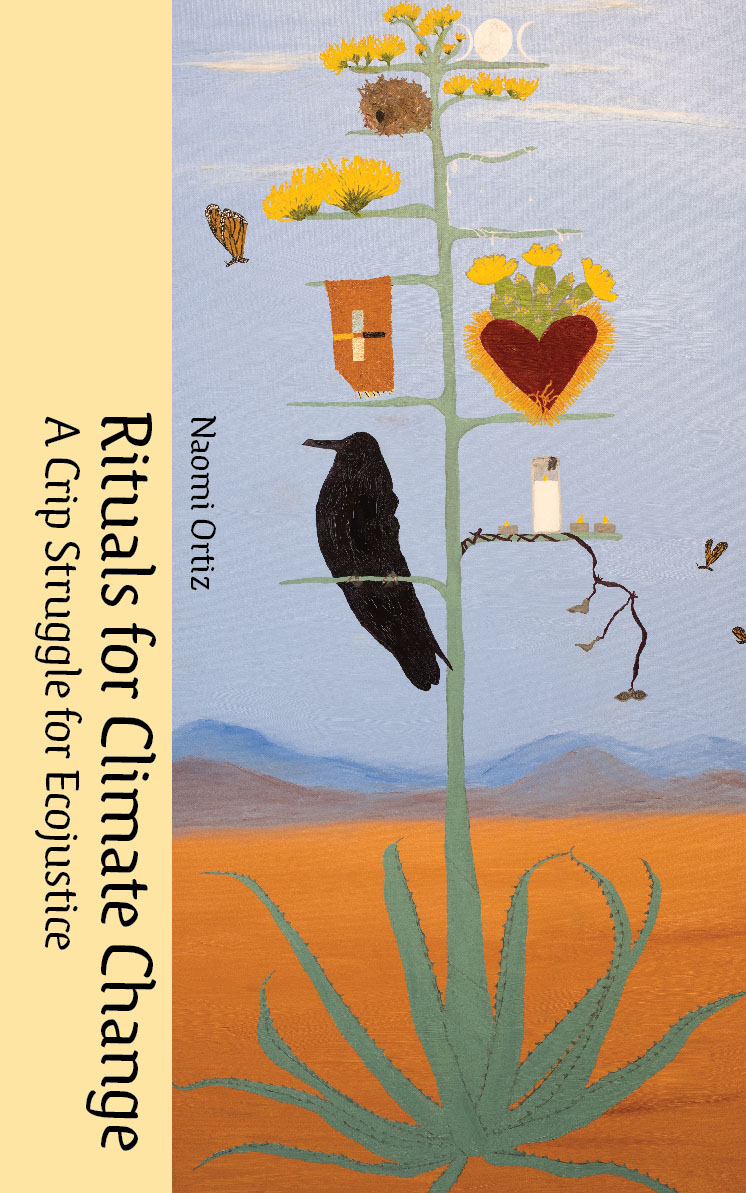
Author: Naomi Ortiz
Earth: Milky Way: punctum books, 2023
https://doi.org/10.53288/0451.1.00
Disability justice and ecojustice are rarely considered together but are in constant conversation in our world. Rituals for Climate Change: A Crip Struggle for Ecojustice, combining poetry and the lyrical essay, doesn’t contain just one point of view but encompasses dialectical perspectives which often exist in contradiction to each other. A disabled person is in need of plastic cups and concerned about the overwhelming plastic in our ecosystems. Ortiz expands on and complicates who is seen as an environmentalist and what being in relationship with the land can look like.
This book is an offering to explore the spiritual question of how to witness. It serves as a companion to those also grappling with the difficult and often unanswerable questions posed by climate change in the borderlands. By exploring the ways body, mind, and cultures both clash with and long for ecojustice,* Rituals for Climate Change* offers an often-overlooked perspective on climate-grief, interdependence, and resilience. Disabled people know how to adapt to a world that is ever changing without considering them.
Tall, Slim & Erect: Portraits of the Presidents

Author: Alex Forman
Introduction by: Ben Ehrenreich
Afterword by: Patric Verrone
Earth, Milky Way: punctum books, 2023
https://doi.org/10.53288/0508.1.00
After stumbling upon a wooden box containing a complete set of miniature wax mold figurines of US presidents at a flea market, artist Alex Forman began photographing each little man, minus their pedestals. Presented for the first time in book format, Forman’s elegant black and white portraits are accompanied by brief biographies composed entirely of appropriated texts cleverly cut and reassembled by the author. What emerges in Tall, Slim & Erect: Portraits of the Presidents is not the tired tale of legendary men and their mythical quest for democracy, but rather, a gossip’s dream: Jefferson could not ride a horse for months due to boils on his backside; Hayes felt a crazed and tender devotion to his sister Fanny; Wilson remained a virgin until twenty-eight. While playfully shedding light on these powerful men, their quirks, bodily functions, and stained sheets, Tall, Slim & Erect ultimately asks the reader to question how history is written and built on hearsay, conjecture, rumor, and repetition.
This title is a second edition, released as part of punctum’s Special Collections project.
July 2023
Resistant Form: Aristophanes and the Comedy of Crisis
Author: Mario Telò
Earth, Milky Way: punctum books, 2023
https://doi.org/10.53288/0445.1.00
Can attending to poetic form help us imagine a radical politics and bridge the gap between pressing contemporary political concerns and an ancient literature that often seems steeped in dynamics of oppression?
The corpus of the fifth-century Athenian playwright Aristophanes includes some of the funniest yet most disturbing comedies of Western literature. His work’s anarchic experimentation with language invites a radically “oversensitive” hyperformalism, a formalistic overanalysis that disrupts, disables, or even abolishes a range of normativities (government, labor, reproduction, gender). Exceeding not just historicist contextualism, but also conventional notions of laughter and the logic of the joke, Resistant Form: Aristophanes and the Comedy of Crisis uses Aristophanes to fully embrace, in the practice of close or “too-close” reading, the etymological and conceptual nexus of crisis, critique, and literary criticism.
These exuberant readings of Birds, Frogs, Lysistrata, and Women at the Thesmophoria, together with the first attempt ever to grapple with the comic style of critical theorists Gilles Deleuze, Achille Mbembe, and Jack Halberstam, connect Aristophanes with contemporary discourses of biopolitics, necrocitizenship, care, labor, and transness, and at the same time disclose a quasi- or para-Aristophanic mode in the written textures of critical theory. Here is a radically new approach to the literary criticism of the premodern—one that materializes the circuit of crisis and critique through a restless inhabitation of the becomings and unbecomings of comic form.
The Tales

Author: Jessica Bozek
Introduction by: Sina Queyras
Earth, Milke Way: punctum books, 2023
https://doi.org/10.53288/0507.1.00
Stitching together a post-apocalyptic history from the scraps of fairy tales, war memorials, hunting songs, and disparate scholarship, Jessica Bozek’s The Tales traces the violence that humans inflict upon one another. As the central narrative of the Lone Survivor becomes revealed through the mouths of various perspectives, Bozek investigates the language that victims and perpetrators alike use to make sense of (and attempt to forget) the aftermath of violence. From ordinary objects—family photographs, sweaters that unravel, old batteries, and lightbulbs—to the remnants of destroyed art and architecture, an annihilated nation is brought into reality, and the Lone Survivor’s story is simultaneously documented and invalidated, becoming “a memorial that will disintegrate over time, gray and fray as most of the dead did not have a chance to.”
This title is a second edition, released as part of punctum’s Special Collections project.